I have written before about the fact that significantly less female than male authors have their work reviewed in major publications.Well, some number crunching has been done since I last posted about this topic and it seems like the disparity does notoriginate with the reviewers, but with the publishers.
...These numbers we found show that the magazines are reviewing female authors in something close to the proportion of books by women published each year. The question now becomes why more books by women are not getting published.
It is unclear why less women are getting published but it seems to have something to do with a possible bias in literary journals.
Of the new writing published in Tin House, Granta,and The Paris Review, around one-third of it was by women. For many fiction writers and poets, publishing in these journals is a first step to getting a book contract. Do women submit work to these magazines at a lower rate than men, or are men’s submissions more likely to get accepted? We can’t be sure. But, as Robin Romm writes in Double X, “The gatekeepers of literary culture—at least at magazines—are still primarily male.” If these gatekeepers are showing a gender bias, there’s not much room to make it up later.
While it is unfortunate to hear that female authors are not properly represented, I am happy to hear that people are trying to get to the bottom of the disparity.
According to a government report, the number of women in managing positions only increased a lousy one percent (from 39 to 40 percent) between 2000 and 2007. This is especially ridiculous considering that women are now the majority in colleges and universities and comprise 46.8% of the labor force.
Nanette Fondas at the Ms. Magazine blog has a fitting acronym to explain why: W.O.M.E.N.
W- "Work-family spillover"
O-"lack of Open, flexible work options"
M-"Masculine model of the 'ideal' worker"
E-"Evaluations of performance punish use of flexible work policies"
N-"No time for activism"
To learn more about the meaning behind the acronym, read Nanette's full post here.
I found Lori's post on feministing about public shirtlessness very thought-provoking. I didn't really take the issue that seriously at first, but then I started thinking about women breast-feeding. Breast feeding isn't obscene, but the sexualization of this pretty utilitarian part of us is what makes it so mothers can't post pictures of themselves nursing their infants on Facebook.
What are your thoughts on the issue? Should feminists take seriously the equal opportunity public toplessness issue since "it's small things like these where big gains can be made"? Or is it just a little too small of an issue to be worthy of our attention?
Photo via The Frisky V Magazine's upcoming Size Issue has a photo spread of two models, one size 2 and one size 12, wearing the exact same clothes and posing similarly. There are more photos at the V Magazine site. Editor in chief Stephen Gan said, ""Big, little, pint-size, plus-size -- every body is beautiful. And this issue is out to prove it."
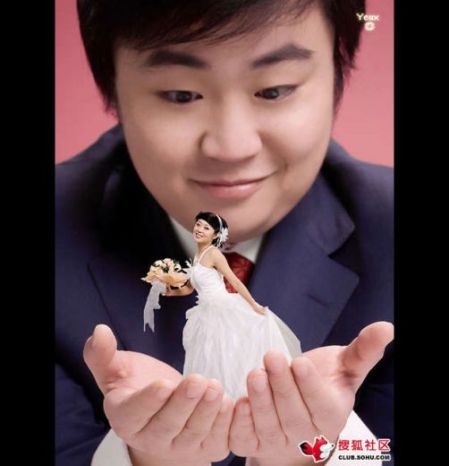
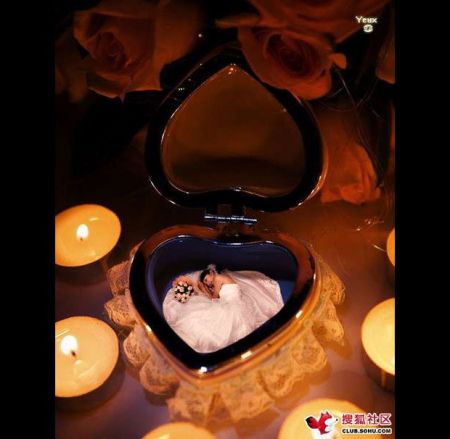
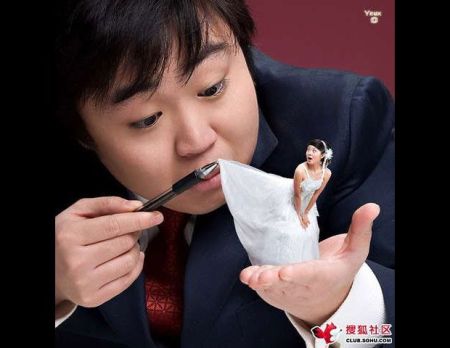
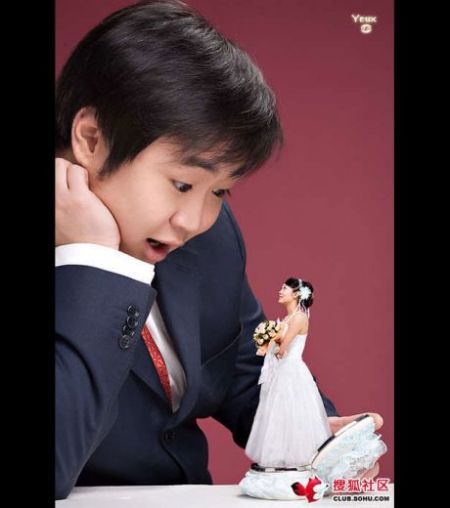
Where to even start about what's wrong with this set of pictures?
I know it's supposed to be cute and adorable - mini brides! - but all I see is a symptom of the larger disease of a mindset that views women as men's property. It tells me that women are to be kept in boxes, taken out to "play" with, and then put away again. I see women as toys. I see women as small enough to not have a choice in the matter. And I see clear and definite power imbalances.
I'm a big fan of Michelle at The Pretty Year - she challenged herself to taking the items currently in her closet and coming up with 250 different looks in 2009, plus $250 for new additions. She posts a picture of every new outfit and in my opinion, her style comes across as simple yet classic. Her outfits and pairings of clothes have influenced me to look at the items in my closet differently, to see what other things I could do with what I have, and to actively mine sales racks for good deals. Practically everything she wears was bought on sale, making a total outfit cost crazy inexpensive.
People's bodies are different and not uniformly made. Take a skirt and five women will wear it differently in five ways. And you know what? THAT'S OK. We're not Barbies, all cut from the same mold. Why should women wear things that don't fit in an attempt to appease trolls online?
Another thing I love about Michelle is her spirit. She writes, "If spending a year trying to throw together cute outfits that fit my body makes me “sleazy,” well… just call me the Queen of Sleaze." Gotta love it.
ABC has yet another article about the "hookup culture" scare titled "Teens: Oral Sex and Casual Prostitution No Biggie." Are you kidding me? If that's not a scare tactic, I don't know what is. The article talks about a new documentary out called (wait for it) ... Oral Sex is the New Goodnight Kiss, by Sharlene Azam.
My sister sent me the link and added, "They don't even mention the word 'boy' in this article. Apparently girls are having sex with themselves." Yet another example of how people commenting on "hookup culture" only focus on girls and the idea of damage to a young woman's purity.
Newsweek had an interesting column this week about "sexting" the semi-clever name for sending naked pictures via text message. A study claims that 1 in 5 teenagers have "sexted." (The study specifies that 22% of girls and 18% of boys have admitted to "sexting.") The column talks about how many of these teenagers are being legally prosecuted for their actions. Both the senders and recipients are being charged: the senders with "production and distribution of child pornography" and the recipients with "possession."
The column focuses on the absurdity of punishing children:
"The argument for hammering every such case seems to be that sending naked pictures might have serious consequences, so let's charge these kids with felonies, which will surely have serious consequences."
I agree completely.
When I was a senior in high school, a freshman girl texted another student a naked picture of herself. The boy forwarded it to his best friend, who then sent it to most of the school. The principal became aware of the situation and ended up kicking the girl off of her sports team. The girl later transferred. The boys who had forwarded the photo weren't punished.
Parents are outraged at this trend, of course. They should be. The Internet's memory is infinite, and text messages are easy to forward. So why are thirteen year olds taking naked pictures of themselves? Teens are not stupid. They know that these phone photos will be forwarded and likely end up on the Internet. I am willing to bet many of these young people do it hoping most of the school will see it. Teens know that nudity is a type of capital. They see failing musicians pose for Playboy and then hear their music on the radio. Or they watch Tila Tequila, a woman with little talent and few clothes, get a television show. Popularity and being a known as "sexy" in high school is the equivalent of an MTV show, and one photo can be all it takes to become "someone" in high school. Everyone at my school knew about the girl whose photo was forwarded. Some boys even put the picture up in their locker, next to Pam Anderson or Adriana Lima.
This trend is going to continue because the reason kids "sext" is not going anywhere. When students value popularity and a label above anything else, they will do anything to get it. The consequences, like the permanence of the Internet, don't matter. We need to give these girls something more to strive for.
The exact same dialogue that Lisa and Jackson have could’ve been filmed in way that made it seem romantic. But in Red Eye, Lisa is visibly uncomfortable with Jackson’s advances. She’s suspicious of him from the outset because he’s just too nice. Like her dad, he keeps on asking her if she’s all right, as if she doesn’t really know how she feels. How many women have been in that situation before?
One of my biggest pet peeves is the question "Are you ok?" sometimes followed by "Are you sure? You don't look fine." I'm not quite exactly sure why it bugs me so much, but I'm beginning to think that like most of my issues with society, the roots lie in our culture's patriarchy.
Most often, I'm asked if I'm ok when I'm just sitting, doing nothing or reading or watching tv or just being in the world. However, I think it's because I'm not actively smiling, as if the presence of a smile on my face would show that I am, indeed, all right. I'm sick of the idea that I have to actively present myself as happy all the time. Most of the time, I'm in a good mood - my default state of mind is generally a good one. It just annoys the crap out of me that people assume I'm not ok or that something's wrong when I'm merely sitting without a joyful expression on my face.
Peoplehavewrittenbefore about how society expects women to look pretty all the time, and at the very least pleasant, which is why women, in particular, are expected to walk around with a smile all the time. I've had people walk past my desk at work and tell me to smile more, as if my natural face expression isn't good enough.
I'll admit - there are times when people have asked me if I'm ok and I haven't been and I've only admitted it a few times. However, I also think that my pissed off, expressionless face is a result of internalized sexism because I don't want to appear overly emotional - society expects women to be hysterical, emotional saps who can't be practical and I distanced myself from that image.
It just annoys me that I have to defend and explain myself and my mood if I'm not wearing a grin all the time.
Very uneven and we find out nothing about her daughters.
Since the speech in Dayton, it's been made clear by both campaigns that families and children are off-limits in political discourse. I agree. If we truly want to make this about issues, then it's low to critique these children who just happen to have parents with political ambitions. Growing up and finding out who you are is hard enough; doing it on a national and international stage is just torture.
However, what happens when the parents use the children for political purposes? Last night in her VP acceptance speech, Palin talked about her sons, one who is going to Iraq next week and her newborn, who was born with Down syndrome. She said:
And as the mother of one of those troops, that is exactly the kind of man I want as commander in chief. I'm just one of many moms who'll say an extra prayer each night for our sons and daughters going into harm's way.
Our son Track is 19.
And one week from tomorrow - September 11th - he'll deploy to Iraq with the Army infantry in the service of his country.
My nephew Kasey also enlisted, and serves on a carrier in the Persian Gulf.
My family is proud of both of them and of all the fine men and women serving the country in uniform. Track is the eldest of our five children.
In our family, it's two boys and three girls in between - my strong and kind-hearted daughters Bristol, Willow, and Piper.
And in April, my husband Todd and I welcomed our littlest one into the world, a perfectly beautiful baby boy named Trig. From the inside, no family ever seems typical.
That's how it is with us.
Our family has the same ups and downs as any other ... the same challenges and the same joys.
Sometimes even the greatest joys bring challenge.
And children with special needs inspire a special love.
To the families of special-needs children all across this country, I have a message: For years, you sought to make America a more welcoming place for your sons and daughters.
I pledge to you that if we are elected, you will have a friend and advocate in the White House.
She's politicizing her family, yet expecting others not to do the same. It's quite a double standard to tell the media to back off, yet champion two of her children and various policies that affect their lives. She's only talking about the children (sons) of hers that actively contribute to the campaign positively (although Piper, the littlest girl is suuuuper cute. Last night during the speech, she was holding her baby brother and she licked her palm to smooth down his hair... CUTE). It's the worst kind of hypocrisy because it tells the girls that they're not to be discussed, unless they're going off to war.
Can we look to politician's families as indicators of their various policy stances? I'm not sure. It's tough to say. It's hard to separate using families as unnecessary and unfounded attacks and seeing the ways politics influence and shape every day lives.
*For those of you confused about why I'm defending Palin from sexist remarks and double standards, it's because she's a woman. Even though I disagree with basically every policy of hers, (including but not limited to her anti-choice, pro-drilling, anti-gay rights, and pro-book banning policies), feminism doesn't mean supporting and defending just the people I agree with - it means everyone. So you can vote for her or not - but don't call her a bitch.
I don't want to repeat too much of what has already been said, but I began thinking about the display of strong female bodies while watching American Gladiators a few weeks ago. Much like the Olympics, the women's uniforms were a lot "sexier" than the men's; for example, womenare often in bikinis (or thingssimiliar). One women's outfit consists of a black leather corset while another wears a skirt. Not only do their outfits reflect this, the pictures and poses often try to make the women look as sexy as possible while the men's photos mostly work to show their physical strength (or potential for physical strength).
Is it possible to show a women's body in public that displays strength but without sexualizing it?
In an athletic setting, I think soccer does a pretty good job on the uniform end. I'm just not sure if we can escape the curse of the bikini, especially in cases like the Olympics where it's required for beach volleyball. Superhero movies don't help either, when Catwoman and Wonder Woman even have to deal with it.
When thinking about it, I was reminded of this picture that does a pretty good job, in my opinion.
I am a little bias, though. That's my great grandma Fern, one of the coolest ladies I know. Not an athletic uniform, but still, the photo displays a sense of strength.
Scarlett Johansson can laugh about it now, but the actress says she was embarrassed by the media coverage of her so-called "e-mail relationship" with Barack Obama.
"It seemed to me to be like a product of extreme sexism, and I kept thinking to myself, 'God, if this was just, like, Kal Penn or George Clooney or any of the other (Obama) surrogates or supporters ... there wouldn't be (any) question about it. Nobody would even talk about it," she said.
Johansson, a vocal supporter of Obama, told the Web site Politico.com in June that she and the Democratic presidential hopeful had been trading e-mails. Obama later told reporters that Johansson doesn't have his personal e-mail address, and that his assistant forwarded one message from Johansson to which he replied.
"I was merely trying to express my delight at Obama's commitment to his campaign in every aspect and his interest and his support (in) his surrogates and his staff and his fellows, and how wonderful and refreshing that is. And it was manipulated into such an unfortunate media frenzy of kind of a nonstory," the 23-year-old actress said Tuesday in an interview from Los Angeles, where she was promoting her new Woody Allen film "Vicky Cristina Barcelona."





 Posts
Posts


