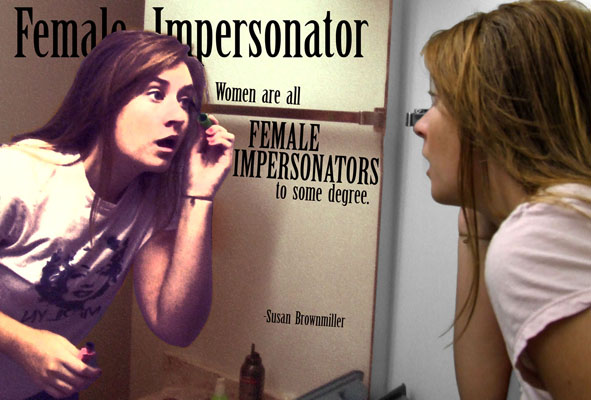
My second most-recent post at Feministe (The Masquerade: I call myself a feminist, therefore I am a feminist) generated some interesting discussion. One comment by Hugo explained some guidelines for men's participation in feminist spaces, called "Step Up and Step Back."
This is exactly what I want all men who are interested in feminist work to understand, and I think it's an important read.
Hugo elaborates on his ideas here.
Showing posts with label Feministe. Show all posts
Showing posts with label Feministe. Show all posts
Sunday, August 22, 2010


Friday, August 20, 2010
The Masquerade: I call myself a feminist, therefore I am a feminist.
(cross-posted from Feministe - wording edited slightly to reflect being posted here)
There’s this guy at my college who calls himself a feminist and, well, I just wouldn’t feel right calling him anything remotely close to a feminist.
I blogged about this student after he attended his first meeting of the feminist organization on my college campus (Students Against Sexism in Society, or SASS), tried to tell its largely female membership how to best run the organization, dominated the conversation, displayed an alarming lack of concern about triggering survivors of sexual assault, told stories of assault experiences that were not his to tell, then called out, by name, people he believed to be rapists.
As someone who has taken on several leaderships within this organization, I had to deal with the aftermath of this situation in which this student (let’s call him Mike) decided to make himself out to be a more involved pro-feminist guy the following term. I was co-president of SASS, but due to class scheduling conflicts, I was unable to attend SASS meetings, so my co-president ran them.
SASS’s major event that term was Take Back The Night and Mike first showed his disrespect for the organization he claimed to want to be a part of when he, on his own initiative, created flyers advertising TBTN as a march “against anti-LGBT violence” (he explained later that he was attempting to attract a larger crowd, not seeming to care that he was doing so by misrepresenting our event). He sent electronic copies of these and several other flyers out to the SASS e-mail list, instructing people to hang them up. I was forced to counter his e-mail, telling the group that those were not the flyers that were meant to be hung up, that Mike was not in charge of publicity, and members would be notified when the correct flyers were ready to be hung up.
I got an angry e-mail from Mike about this. He called me rude, stupidly hostile, “an immature insecure leader intent on doing nothing but touting her title around and impeding progress” and ended on this note:
He showed a worrisome disregard for survivors of sexual assault (the same people he claimed to want to help by taking part in TBTN), disrespected SASS (by misrepresenting one of its events), and insulted an elected leader of an organization that is legitimately concerned about the interests of women after that leader took measures to ensure the integrity of the group. He made it clear that his interest lied not with SASS or even helping women.
The worst part is that in three separate e-mails that Mike sent me, none of which offered a fair critique and which seemed to be nothing more than a backlash against me acting as an officer, he insinuated time and time again that he was a better feminist than I am.
I’ve been trying to write this post for months now, but I’ve found this situation incredibly difficult to deal with. Being insulted is never easy, but when it comes from someone who claims to be an ally it’s not only confusing but incredibly hurtful. It stings to be called a bad feminist by a guy who doesn’t even seem to understand what feminism is and who showed little respect for women, some of the people that he should have been interested in fighting for.
I know I should just brush off these insults. I usually can. But it really bothers me when someone like Mike takes on the label of feminist, a label I wear with pride, when it just doesn’t apply to the type of actions he has undertaken. This is the kind of thing that undermines the work of people who actually want to make the world a better place for women and other oppressed groups. When people like Mike can call themselves feminists, I usually end up going to bed frustrated and a little hurt.
There’s this guy at my college who calls himself a feminist and, well, I just wouldn’t feel right calling him anything remotely close to a feminist.
I blogged about this student after he attended his first meeting of the feminist organization on my college campus (Students Against Sexism in Society, or SASS), tried to tell its largely female membership how to best run the organization, dominated the conversation, displayed an alarming lack of concern about triggering survivors of sexual assault, told stories of assault experiences that were not his to tell, then called out, by name, people he believed to be rapists.
As someone who has taken on several leaderships within this organization, I had to deal with the aftermath of this situation in which this student (let’s call him Mike) decided to make himself out to be a more involved pro-feminist guy the following term. I was co-president of SASS, but due to class scheduling conflicts, I was unable to attend SASS meetings, so my co-president ran them.
SASS’s major event that term was Take Back The Night and Mike first showed his disrespect for the organization he claimed to want to be a part of when he, on his own initiative, created flyers advertising TBTN as a march “against anti-LGBT violence” (he explained later that he was attempting to attract a larger crowd, not seeming to care that he was doing so by misrepresenting our event). He sent electronic copies of these and several other flyers out to the SASS e-mail list, instructing people to hang them up. I was forced to counter his e-mail, telling the group that those were not the flyers that were meant to be hung up, that Mike was not in charge of publicity, and members would be notified when the correct flyers were ready to be hung up.
I got an angry e-mail from Mike about this. He called me rude, stupidly hostile, “an immature insecure leader intent on doing nothing but touting her title around and impeding progress” and ended on this note:
Are you going to do ANYTHING for Take Back the Night? Or are you just going to impede the progress of smarter, more political members of the club you are a tyrant of?Interestingly, the language Mike utilized in his e-mail was very similar to language in e-mails I had received earlier in the year from a female SASS member who fundamentally disagreed with my leadership style. I felt that both e-mail attacks were unwarranted, as they took place after I exercised due responsibility as an elected officer of SASS. The difference lies in the fact that the female SASS member who criticized me (however harshly or unjustly) could clearly be viewed as acting in what she felt was the best interest of SASS as a feminist organization that she cared about. Mike, however, could not be said to have had the same motives.
He showed a worrisome disregard for survivors of sexual assault (the same people he claimed to want to help by taking part in TBTN), disrespected SASS (by misrepresenting one of its events), and insulted an elected leader of an organization that is legitimately concerned about the interests of women after that leader took measures to ensure the integrity of the group. He made it clear that his interest lied not with SASS or even helping women.
The worst part is that in three separate e-mails that Mike sent me, none of which offered a fair critique and which seemed to be nothing more than a backlash against me acting as an officer, he insinuated time and time again that he was a better feminist than I am.
I’ve been trying to write this post for months now, but I’ve found this situation incredibly difficult to deal with. Being insulted is never easy, but when it comes from someone who claims to be an ally it’s not only confusing but incredibly hurtful. It stings to be called a bad feminist by a guy who doesn’t even seem to understand what feminism is and who showed little respect for women, some of the people that he should have been interested in fighting for.
I know I should just brush off these insults. I usually can. But it really bothers me when someone like Mike takes on the label of feminist, a label I wear with pride, when it just doesn’t apply to the type of actions he has undertaken. This is the kind of thing that undermines the work of people who actually want to make the world a better place for women and other oppressed groups. When people like Mike can call themselves feminists, I usually end up going to bed frustrated and a little hurt.
Wednesday, August 18, 2010
Parental Advisory: Explicit, Unladylike S**t
(Cross-posted from Feministe)
It's true. I swear a lot. It's a fact that gets brought up frequently at random times by people who have spoken with me.
Apparently, I shouldn't swear.
Why is this?
A) It makes me sound unintelligent
B) It makes me sound angry
C) It makes me sound trashy
D) It's unladylike
Trick question. It's actually all of the above, according to a number of people I've spoken to.
I understand that swearing is not appropriate in every situation. I make sure to censor myself when I am at work, around people I am not acqainted with, or around people I know are offended by my language. However, when I have been told that swearing makes me sound unintelligent, angry, trashy, or unladylike, it has not been because the person making these statements has been offended by my language. It seems to come from a place of concern about how I will be perceived if people hear me using vulgar language.
Fair enough. Certain segments of the society I live in have problems with women doing "unladylike" things like wearing pants, having sex with multiple partners, drinking, and swearing. Women being looked down upon for engaging in what some deem unacceptable behavior is not an uncommon experience.
I know that that, quite frankly, is bullshit, and when people express their concern about what people will think about me because I swear, I tend to laugh it off.
Then I met a girl a few days ago who is a few years younger than myself. She didn't talk much, but when she did finally open her mouth, some of the first words she
spoke were what some people would consider vulgar. I was shocked by this, and when I thought back on this later, I was surprised that I felt this way.
I swear. My friends swear. I listen to music that comes with parental advisory labels. In none of these situations am I ever shocked by or give a second thought to the "vulgar" language. But when a girl in her teens swore the first time I met her, I froze.
I was thinking about this. I don't have a problem with women swearing, so did my reaction have to do with this girl's age? If so, does that mean I buy into the idea that young girls are innocent, and that violating that sense of innocence somehow violates the essence of their girlhood?
I hope not. The idea of the innocent, virtuous woman plays into patriarchal ideas that women needing to be protected by men, the only people who can stand guard over all that is good about them. And that's certainly not how I want to think about young women who use words in the same way that I do.
It's true. I swear a lot. It's a fact that gets brought up frequently at random times by people who have spoken with me.
Apparently, I shouldn't swear.
Why is this?
A) It makes me sound unintelligent
B) It makes me sound angry
C) It makes me sound trashy
D) It's unladylike
Trick question. It's actually all of the above, according to a number of people I've spoken to.
I understand that swearing is not appropriate in every situation. I make sure to censor myself when I am at work, around people I am not acqainted with, or around people I know are offended by my language. However, when I have been told that swearing makes me sound unintelligent, angry, trashy, or unladylike, it has not been because the person making these statements has been offended by my language. It seems to come from a place of concern about how I will be perceived if people hear me using vulgar language.
Fair enough. Certain segments of the society I live in have problems with women doing "unladylike" things like wearing pants, having sex with multiple partners, drinking, and swearing. Women being looked down upon for engaging in what some deem unacceptable behavior is not an uncommon experience.
I know that that, quite frankly, is bullshit, and when people express their concern about what people will think about me because I swear, I tend to laugh it off.
Then I met a girl a few days ago who is a few years younger than myself. She didn't talk much, but when she did finally open her mouth, some of the first words she
spoke were what some people would consider vulgar. I was shocked by this, and when I thought back on this later, I was surprised that I felt this way.
I swear. My friends swear. I listen to music that comes with parental advisory labels. In none of these situations am I ever shocked by or give a second thought to the "vulgar" language. But when a girl in her teens swore the first time I met her, I froze.
I was thinking about this. I don't have a problem with women swearing, so did my reaction have to do with this girl's age? If so, does that mean I buy into the idea that young girls are innocent, and that violating that sense of innocence somehow violates the essence of their girlhood?
I hope not. The idea of the innocent, virtuous woman plays into patriarchal ideas that women needing to be protected by men, the only people who can stand guard over all that is good about them. And that's certainly not how I want to think about young women who use words in the same way that I do.
Monday, August 16, 2010
Consent and coming out
(cross-posted from Feministe)
Knowing your preferences and your limits is an important part of having a satisfying sex life. For most of my life as a sexually active person, I could have talked about these ideas, but it wasn't until more recently that I was finally able to practice what I often preached.
This is tied to the fact that I came out (selectively) as queer in 2009.
Coming out was not easy for me. I starting coming out to myself late in my first year at college, but I distinctly remember looking myself in the mirror and seeing "QUEER" stamped across my forehead. For a while, thinking of myself in that way was so difficult that I shoved myself back in the closet, determining that what had just happened must have been a weird symptom of stress or something. In the meantime, I was in a long distance relationship with a boyfriend I'd been with since high school. We'd see each other about once a month and we almost always had sex when we were together.
Fast forward one school year and I had come around to certain things about myself.
I was definitely queer. I came out to my boyfriend right away as bisexual (which is no longer a label I use). He was supportive and we stayed together because this did not appear to change our relationship. There was a problem, however. I still was not terribly interested in sex with my boyfriend.
This was something I didn't realize fully until I had a new partner, but I had never been very interested in the sex I had had with men in the past. My boyfriend and I did have sex, and it was something I had convinced myself (dishonestly) that I wanted. I had bought into the idea that I was supposed to want to have sex with my boyfriend, even when I could tell that I was not truly interested. The sex was not terrible or selfish on his part, but my interest only seemed to hold for a very brief time. This created a situation in which I rarely initiated sex. It also meant that enthusiastic consent was not something that was practiced in our relationship.
I knew my boyfriend wanted sex because he almost always made the first move. While he did not often check in with me during sex, something that may have given some indication of my lack of interest, he was good at asking me if I wanted sex before we did anything. I always said I did, whether or not it was really true, but I was aware that this wasn't the kind of consent that should take place in these situations. I knew about enthusiastic consent and I often spoke to people about the idea. I just couldn't bring myself to amend the situation with my boyfriend. It would be messy to explain that what had become a common practice did not actually fit with my personal definition of consent.
Our relationship ended a few months later for reasons unrelated to sex. I don't want it to sound like my ex was a bad guy. He did practice affirmative consent (having sex when I said, yes, I wanted to), but it didn't change the fact that I just wasn't into having sex with him and he didn't seem to notice.
Once that relationship was over, I had the time to come to terms with my queerness. I quickly realized that while I had thought that I had enjoyed sex with men before, I had not been completely honest with myself. It was a bit shocking to realize that the sex I had had in the past didn't fit my personal ideas about proper consent, but in a way it makes sense. If you can't be honest with yourself about your desires, then it's hard to be honest about what you want sexually, and not being honest about what you want makes consent very tricky. Once I was able to be true to my desires, I found myself wanting sex more often and being able to enjoy it on new levels. This gave me the freedom to navigate new rules of consent.
I've been with my current partner for almost a year now and something that I am incredibly pleased with is how effortlessly we've been able to have awesome, feminism-informed sex, and how easy it was to communicate my ideas about consent. We practice enthusiastic, affirmative consent with ease and for the first time in my life I can consider myself truly satisfied.
Knowing your preferences and your limits is an important part of having a satisfying sex life. For most of my life as a sexually active person, I could have talked about these ideas, but it wasn't until more recently that I was finally able to practice what I often preached.
This is tied to the fact that I came out (selectively) as queer in 2009.
Coming out was not easy for me. I starting coming out to myself late in my first year at college, but I distinctly remember looking myself in the mirror and seeing "QUEER" stamped across my forehead. For a while, thinking of myself in that way was so difficult that I shoved myself back in the closet, determining that what had just happened must have been a weird symptom of stress or something. In the meantime, I was in a long distance relationship with a boyfriend I'd been with since high school. We'd see each other about once a month and we almost always had sex when we were together.
Fast forward one school year and I had come around to certain things about myself.
I was definitely queer. I came out to my boyfriend right away as bisexual (which is no longer a label I use). He was supportive and we stayed together because this did not appear to change our relationship. There was a problem, however. I still was not terribly interested in sex with my boyfriend.
This was something I didn't realize fully until I had a new partner, but I had never been very interested in the sex I had had with men in the past. My boyfriend and I did have sex, and it was something I had convinced myself (dishonestly) that I wanted. I had bought into the idea that I was supposed to want to have sex with my boyfriend, even when I could tell that I was not truly interested. The sex was not terrible or selfish on his part, but my interest only seemed to hold for a very brief time. This created a situation in which I rarely initiated sex. It also meant that enthusiastic consent was not something that was practiced in our relationship.
I knew my boyfriend wanted sex because he almost always made the first move. While he did not often check in with me during sex, something that may have given some indication of my lack of interest, he was good at asking me if I wanted sex before we did anything. I always said I did, whether or not it was really true, but I was aware that this wasn't the kind of consent that should take place in these situations. I knew about enthusiastic consent and I often spoke to people about the idea. I just couldn't bring myself to amend the situation with my boyfriend. It would be messy to explain that what had become a common practice did not actually fit with my personal definition of consent.
Our relationship ended a few months later for reasons unrelated to sex. I don't want it to sound like my ex was a bad guy. He did practice affirmative consent (having sex when I said, yes, I wanted to), but it didn't change the fact that I just wasn't into having sex with him and he didn't seem to notice.
Once that relationship was over, I had the time to come to terms with my queerness. I quickly realized that while I had thought that I had enjoyed sex with men before, I had not been completely honest with myself. It was a bit shocking to realize that the sex I had had in the past didn't fit my personal ideas about proper consent, but in a way it makes sense. If you can't be honest with yourself about your desires, then it's hard to be honest about what you want sexually, and not being honest about what you want makes consent very tricky. Once I was able to be true to my desires, I found myself wanting sex more often and being able to enjoy it on new levels. This gave me the freedom to navigate new rules of consent.
I've been with my current partner for almost a year now and something that I am incredibly pleased with is how effortlessly we've been able to have awesome, feminism-informed sex, and how easy it was to communicate my ideas about consent. We practice enthusiastic, affirmative consent with ease and for the first time in my life I can consider myself truly satisfied.
Thursday, August 12, 2010
Enter Madam Buzzkill
(cross-posted from Feministe)
**Trigger warning for description of violence**
It's a Friday night after a long work week. A group of friends, four men and two women, sits down for drinks at someone's house to unwind. All seems well. There is banter all around the table. Someone turns on a radio and music mixes with the sharp notes of quick laughter. A few hours later, a number of drinks have been had and everyone is feeling good, especially one young man who is singing an out of tune version of a once-popular song to the young woman sitting next to him. This young man picks up his drink and his voice soars ever louder and off key as his male friends laugh and cheer him on, finding his antics quite amusing. The young man eventually sits down next to the woman he had been serenading. She is texting someone. The young man next to her does not like this and tries to take her phone. She resists. He tightens his grip on her hand and arm and is eventually joined by another man who grips the woman's other arm. As the three other people at the table watch and laugh at the developing struggle, the woman still does not let go. For several long moments the Singer persists until he bites the woman's arm, gives one last yank at her phone, and finally he and his accomplice give up. The young woman is in shock. She does not register the pain in her arms yet. Instead, she feels betrayed by the others sitting at the same table who watched this behavior, which is already beginning to leave a bruise on her arm, and did nothing but laugh. In effect, they encouraged it.
This woman sits in silence while the others at the table continue to laugh and drink. She gets up to pour herself a glass of water. When she returns, the young man who had serenaded her and tried to take her phone from her is standing behind his seat, drink still in hand, swaying on his feet, clearly very intoxicated. His male friends are laughing at him. Every slurred word, every stumbling footstep seems to produce a new wave of hilarity. As the drunk young man spills his drink and is greeted by even more laughter, the woman stands up. She has had enough.
Enter Madam Buzzkill.
The above story is my own. A drunk young man who I considered my friend tried to take my phone and in the process, bit my arm while another, less-intoxicated man had me by my other arm. The young man was clearly very intoxicated, but none of the other people sitting with us stepped in to stop his behavior from escalating to physical violence. I finally had enough of everyone's inaction and even encouragement of this man's behavior, so I pulled this young man aside to have a talk with him about how his behavior was unacceptable and could potentially get him into a lot of trouble if he wasn't careful when he was out in public. When I explained that he had bitten me he looked shocked. He said he didn't remember it and that he was sorry. I told him that his inability to remember was a cause for concern and he agreed. As I got him to drink some water he explained how he didn't want to look weak to his friends
Before I could address this with him, the other woman in our party came over to where we were talking, listened for a few moments, then essentially began apologizing for my behavior. I would say something and this woman would suggest an alternative and say something about me along the lines of, "I'm sorry. This lady over here, she's kind of uptight about these things." In fact, this woman explained to me later that she basically reinforced that message when she got the young man alone. In essence, she was explaining how I tend to be a buzzkill.
Therein lies the problem. At least in American society, the one I am familiar with, people are socialized to stand by and let things just happen when the situation involves alcohol. Calling people out for unacceptable behavior while drinking is deeply frowned upon because, hey, everyone is just trying to have a good time, right? Who wants to be the downer who warns that maybe Billy shouldn't drink another beer when everyone else is having a good time laughing at how he's wearing his pants on his head? No one wants to be ostracized for not going along with the feel good vibes that come with a few drinks.
Truth is, alcohol does not promote good decision making, and a good sense of community responsibility is important.
A feeling of responsibility to those you drink with would make it easier to step in when a situation appears problematic. Is someone acting sloppy? Say something. Is someone too drunk to be going off alone with someone else? Say something. Being able to speak up in these situations requires a deeper sense of community than what may be accomplished by merely sharing a few drinks with some people you may or may not want to see again.
This is a complicated idea to develop in the minds of most people who drink to relax or perhaps even escape. Most people don't want to add any responsibility to the mix because it's extra work. When I first started drinking, I did so with a carefully selected group of women. We were all good friends and without any prompting we felt comfortable discussing our limits with each other. With that knowledge established before we started drinking, we had no problem looking out for each other. Once I felt comfortable doing this with my friends, it was an easy step toward doing the same thing with people I was less familiar with when I felt that the situation called for intervention.
Simple awareness and a sense of responsibility in bystanders can help prevent people from embarassing themselves and can even help prevent more serious issues such as sexual assault. However, speaking up when socialization demands our silent compliance is not easy. It will take practice to get used to this idea of action, and it may be met with hostility or resistance. But I have hope that in the future, instead of being viewed as a buzzkill, an individual who steps in could be viewed as acting out of love.
**Trigger warning for description of violence**
It's a Friday night after a long work week. A group of friends, four men and two women, sits down for drinks at someone's house to unwind. All seems well. There is banter all around the table. Someone turns on a radio and music mixes with the sharp notes of quick laughter. A few hours later, a number of drinks have been had and everyone is feeling good, especially one young man who is singing an out of tune version of a once-popular song to the young woman sitting next to him. This young man picks up his drink and his voice soars ever louder and off key as his male friends laugh and cheer him on, finding his antics quite amusing. The young man eventually sits down next to the woman he had been serenading. She is texting someone. The young man next to her does not like this and tries to take her phone. She resists. He tightens his grip on her hand and arm and is eventually joined by another man who grips the woman's other arm. As the three other people at the table watch and laugh at the developing struggle, the woman still does not let go. For several long moments the Singer persists until he bites the woman's arm, gives one last yank at her phone, and finally he and his accomplice give up. The young woman is in shock. She does not register the pain in her arms yet. Instead, she feels betrayed by the others sitting at the same table who watched this behavior, which is already beginning to leave a bruise on her arm, and did nothing but laugh. In effect, they encouraged it.
This woman sits in silence while the others at the table continue to laugh and drink. She gets up to pour herself a glass of water. When she returns, the young man who had serenaded her and tried to take her phone from her is standing behind his seat, drink still in hand, swaying on his feet, clearly very intoxicated. His male friends are laughing at him. Every slurred word, every stumbling footstep seems to produce a new wave of hilarity. As the drunk young man spills his drink and is greeted by even more laughter, the woman stands up. She has had enough.
Enter Madam Buzzkill.
The above story is my own. A drunk young man who I considered my friend tried to take my phone and in the process, bit my arm while another, less-intoxicated man had me by my other arm. The young man was clearly very intoxicated, but none of the other people sitting with us stepped in to stop his behavior from escalating to physical violence. I finally had enough of everyone's inaction and even encouragement of this man's behavior, so I pulled this young man aside to have a talk with him about how his behavior was unacceptable and could potentially get him into a lot of trouble if he wasn't careful when he was out in public. When I explained that he had bitten me he looked shocked. He said he didn't remember it and that he was sorry. I told him that his inability to remember was a cause for concern and he agreed. As I got him to drink some water he explained how he didn't want to look weak to his friends
Before I could address this with him, the other woman in our party came over to where we were talking, listened for a few moments, then essentially began apologizing for my behavior. I would say something and this woman would suggest an alternative and say something about me along the lines of, "I'm sorry. This lady over here, she's kind of uptight about these things." In fact, this woman explained to me later that she basically reinforced that message when she got the young man alone. In essence, she was explaining how I tend to be a buzzkill.
Therein lies the problem. At least in American society, the one I am familiar with, people are socialized to stand by and let things just happen when the situation involves alcohol. Calling people out for unacceptable behavior while drinking is deeply frowned upon because, hey, everyone is just trying to have a good time, right? Who wants to be the downer who warns that maybe Billy shouldn't drink another beer when everyone else is having a good time laughing at how he's wearing his pants on his head? No one wants to be ostracized for not going along with the feel good vibes that come with a few drinks.
Truth is, alcohol does not promote good decision making, and a good sense of community responsibility is important.
A feeling of responsibility to those you drink with would make it easier to step in when a situation appears problematic. Is someone acting sloppy? Say something. Is someone too drunk to be going off alone with someone else? Say something. Being able to speak up in these situations requires a deeper sense of community than what may be accomplished by merely sharing a few drinks with some people you may or may not want to see again.
This is a complicated idea to develop in the minds of most people who drink to relax or perhaps even escape. Most people don't want to add any responsibility to the mix because it's extra work. When I first started drinking, I did so with a carefully selected group of women. We were all good friends and without any prompting we felt comfortable discussing our limits with each other. With that knowledge established before we started drinking, we had no problem looking out for each other. Once I felt comfortable doing this with my friends, it was an easy step toward doing the same thing with people I was less familiar with when I felt that the situation called for intervention.
Simple awareness and a sense of responsibility in bystanders can help prevent people from embarassing themselves and can even help prevent more serious issues such as sexual assault. However, speaking up when socialization demands our silent compliance is not easy. It will take practice to get used to this idea of action, and it may be met with hostility or resistance. But I have hope that in the future, instead of being viewed as a buzzkill, an individual who steps in could be viewed as acting out of love.
Tuesday, August 10, 2010
Speak up and expect to be dismissed, petulant child.
(cross-posted from Feministe)
The past few months of my life have made one thing startlingly clear: At 21 years, I am too young to be taken seriously by some people who are older than myself, and quite frankly, it’s beginning to piss me off.
I am not the type of woman who has ever been able to watch injustice unfold and do nothing. I often confront people who I believe are acting in hurtful ways because I hope that people would do the same for me so I could learn from my mistakes. In fact, that is the only way I ever have learned much.
I have stood up to people older than myself and this has almost never turned out well.
Start with Situation #1.
My hometown is a small place, and unfortunately, it is not very open-minded. This town is not often outwardly hostile, but I have never been comfortable with the bigotry displayed by many individuals there.
A few days ago the ex-fire chief updated his Facebook status, wondering if a type of deodorant was for men or for women. I saw this as a good opportunity to voice my opinion that if he liked it, I hoped it wouldn’t matter gender it was “meant” for. My comment was immediately followed by another grown man from the community saying that I must have meant that it was ok for the poster to be a “homo.”
I immediately commented back to clarify that I had meant nothing of the nature and that using the word “homo” as an insult was offensive and hurtful.
This man never acknowledged my words and instead took to making fun of me. Eventually another woman commented and told me that using “homo” as a type of insult in this instance was not offensive because the person being called the “homo” was not offended by it. I replied that just because the person being insulted wasn’t offended doesn’t make the use of the word any less hurtful and that excusing this behavior was problematic. I was then told off by that woman who called me “sweetie,” said I knew nothing about her, and that God would be the final judge.
It was the “sweetie” thing that bothered me the most, because with that languge, the kind that is usually used to address children, it was blatantly clear that she was through listening to me. She had already made up her mind that I had nothing worthwhile to say. Turns out I was right about this.
Annoyed and feeling as if this woman had a completely false idea of what I was trying to accomplish, I sent her a private message offering to talk in detail. She made it clear that she did not feel a discussion with me would offer her anything, an attitude which she indicated through her constant claims that she has more “life experience” than I do, and the fact that she has attained higher levels of education.
Now, on to Situation #2.
At the end of June I attended a meeting for queer youth. At this meeting, there was a misunderstanding between myself and another female attendee that ended with the woman getting very upset and leveling several insults at me, including one about my personal life that was completely irrelevant to the current situation. She then stormed out of the building.
A few moments after she left, the man running the meeting turned to me and told me, in essence, that it was my fault that she had verbally attacked me. He then got up and started doing some light cleaning. This act of silent approval of the woman’s behavior left me feeling attacked and without an ally at this meeting, a feeling that prompted me to leave and not return that night.
So a few weeks later I messaged this man on Facebook (as I was without a phone). I explained how disappointed I was with his behavior, how he had made me feel unwelcome, and how I felt that it was inappropriate for him to place the blame squarely on my shoulders when I was the one who had been attacked.
He responded that I should come back and see him if I wanted to have this discussion, which was fair, but I explained that in my current situation, I had no transportation. He told me that was my choice, and I said I was disappointed in him not trying to work something out with me. He responded:
Both of the people mentioned above are twice my age and both of them clearly had problems with me, but not outwardly so until I challenged them on their behavior. However, while I’ve been sitting on this post, I’ve tried to put myself in their shoes because I feel that that is only fair, and I think I can relate to them to some extent.
It’s difficult and uncomfortable to be challenged by people who are strong in their convictions, no matter their age. It makes me feel insecure about my own ideas and beliefs when this happens to me. It must be especially difficult when the person challenging you is much younger because I know that most people who are much older than me tend to be of the mind that children are not supposed to question their parents or authority in general, so when this role of submissive child is broken, I can imagine it being shocking. And maybe this shock is why these two people spoke down to me when I voiced my criticisms.
However, this dissmissing of my ideas based on my age leaves a big problem. If people set some arbitrary age until which they will not take people seriously, they are missing out on many opportunities to learn valuable lessons. People of various ages and life experiences (and I do not buy into the idea that just because someone has been alive longer that they have more “life experience” than someone younger) will bring very different ideas about how to solve problems, and it is that kind of melding of ideas that is most likely to come to practical and workable solutions. But it also requires that people want to listen to others who may not agree with us or may be younger than us.
I am open to the idea that perhaps I could have handled myself better in these situations, and I have been giving this some serious thought. Should I not have said anything? Would these people have been more receptive if I had sugar coated my criticism? Would they have taken me seriously then? Will people who perceive me as angry (rightfully or not) ever be able or willing to truly listen to me?
All I know for sure is that I did make every attempt to express myself firmly but not impolitely. I know that what I had to say was not going to be easy to hear, but I tried to say it in the least offensive way possible. But my attempts were met with dismissal and cruelty. Neither of these people seemed to have listened to anything I said. Their behavior was, as they made clear, largely based on my age.
These people that I have been bumping heads with are hiding behind the idea that their years give them experience that no idea in my head will make up for. None of my thoughts or my own experiences mean anything simply because these people have been alive longer and, in their minds, know better. This is extremely frustrating because it makes no sense. Dismissing someone based on their age and supposed lack of experience is easy, but it is harmful, too. If we cut people out of our lives by believing they have nothing to teach us, how much can we really know about the world we’re living in?
The past few months of my life have made one thing startlingly clear: At 21 years, I am too young to be taken seriously by some people who are older than myself, and quite frankly, it’s beginning to piss me off.
I am not the type of woman who has ever been able to watch injustice unfold and do nothing. I often confront people who I believe are acting in hurtful ways because I hope that people would do the same for me so I could learn from my mistakes. In fact, that is the only way I ever have learned much.
I have stood up to people older than myself and this has almost never turned out well.
Start with Situation #1.
My hometown is a small place, and unfortunately, it is not very open-minded. This town is not often outwardly hostile, but I have never been comfortable with the bigotry displayed by many individuals there.
A few days ago the ex-fire chief updated his Facebook status, wondering if a type of deodorant was for men or for women. I saw this as a good opportunity to voice my opinion that if he liked it, I hoped it wouldn’t matter gender it was “meant” for. My comment was immediately followed by another grown man from the community saying that I must have meant that it was ok for the poster to be a “homo.”
I immediately commented back to clarify that I had meant nothing of the nature and that using the word “homo” as an insult was offensive and hurtful.
This man never acknowledged my words and instead took to making fun of me. Eventually another woman commented and told me that using “homo” as a type of insult in this instance was not offensive because the person being called the “homo” was not offended by it. I replied that just because the person being insulted wasn’t offended doesn’t make the use of the word any less hurtful and that excusing this behavior was problematic. I was then told off by that woman who called me “sweetie,” said I knew nothing about her, and that God would be the final judge.
It was the “sweetie” thing that bothered me the most, because with that languge, the kind that is usually used to address children, it was blatantly clear that she was through listening to me. She had already made up her mind that I had nothing worthwhile to say. Turns out I was right about this.
Annoyed and feeling as if this woman had a completely false idea of what I was trying to accomplish, I sent her a private message offering to talk in detail. She made it clear that she did not feel a discussion with me would offer her anything, an attitude which she indicated through her constant claims that she has more “life experience” than I do, and the fact that she has attained higher levels of education.
Now, on to Situation #2.
At the end of June I attended a meeting for queer youth. At this meeting, there was a misunderstanding between myself and another female attendee that ended with the woman getting very upset and leveling several insults at me, including one about my personal life that was completely irrelevant to the current situation. She then stormed out of the building.
A few moments after she left, the man running the meeting turned to me and told me, in essence, that it was my fault that she had verbally attacked me. He then got up and started doing some light cleaning. This act of silent approval of the woman’s behavior left me feeling attacked and without an ally at this meeting, a feeling that prompted me to leave and not return that night.
So a few weeks later I messaged this man on Facebook (as I was without a phone). I explained how disappointed I was with his behavior, how he had made me feel unwelcome, and how I felt that it was inappropriate for him to place the blame squarely on my shoulders when I was the one who had been attacked.
He responded that I should come back and see him if I wanted to have this discussion, which was fair, but I explained that in my current situation, I had no transportation. He told me that was my choice, and I said I was disappointed in him not trying to work something out with me. He responded:
Your inability to to get or find transportation is no concern of mine. You want to be treated as an adult, then start behaving as one not as a petulant child.This was the end of our correspondence, and it left me incredibly ticked off. Not only did I feel that my words did not warrant such a critical response, but he was completely dismissive. Not once did he acknowledge what I had said, or give any sort of idea that if I were to find a way to meet with him that he would acknowledge what I had said. He kept things on his terms until he decided to end our correspondence. That’s the problem in both of these situations.
Both of the people mentioned above are twice my age and both of them clearly had problems with me, but not outwardly so until I challenged them on their behavior. However, while I’ve been sitting on this post, I’ve tried to put myself in their shoes because I feel that that is only fair, and I think I can relate to them to some extent.
It’s difficult and uncomfortable to be challenged by people who are strong in their convictions, no matter their age. It makes me feel insecure about my own ideas and beliefs when this happens to me. It must be especially difficult when the person challenging you is much younger because I know that most people who are much older than me tend to be of the mind that children are not supposed to question their parents or authority in general, so when this role of submissive child is broken, I can imagine it being shocking. And maybe this shock is why these two people spoke down to me when I voiced my criticisms.
However, this dissmissing of my ideas based on my age leaves a big problem. If people set some arbitrary age until which they will not take people seriously, they are missing out on many opportunities to learn valuable lessons. People of various ages and life experiences (and I do not buy into the idea that just because someone has been alive longer that they have more “life experience” than someone younger) will bring very different ideas about how to solve problems, and it is that kind of melding of ideas that is most likely to come to practical and workable solutions. But it also requires that people want to listen to others who may not agree with us or may be younger than us.
I am open to the idea that perhaps I could have handled myself better in these situations, and I have been giving this some serious thought. Should I not have said anything? Would these people have been more receptive if I had sugar coated my criticism? Would they have taken me seriously then? Will people who perceive me as angry (rightfully or not) ever be able or willing to truly listen to me?
All I know for sure is that I did make every attempt to express myself firmly but not impolitely. I know that what I had to say was not going to be easy to hear, but I tried to say it in the least offensive way possible. But my attempts were met with dismissal and cruelty. Neither of these people seemed to have listened to anything I said. Their behavior was, as they made clear, largely based on my age.
These people that I have been bumping heads with are hiding behind the idea that their years give them experience that no idea in my head will make up for. None of my thoughts or my own experiences mean anything simply because these people have been alive longer and, in their minds, know better. This is extremely frustrating because it makes no sense. Dismissing someone based on their age and supposed lack of experience is easy, but it is harmful, too. If we cut people out of our lives by believing they have nothing to teach us, how much can we really know about the world we’re living in?
Subscribe to:
Posts (Atom)

 Posts
Posts


