Showing posts with label Advertising. Show all posts

Wednesday, July 6, 2011

"We Need Fashion to Catch Up To Women of Size"

I love this piece over at Jezebel. In it, Dodai Stewart comments on an interview with Velvet d'Amour, a plus-sized actress, model and photographer. Some of my favorite quotes by d'Amour that are mentioned in the Jezebel piece are:


Fleshy, curvy women have been relegated to men's magazines, whilst edgy
editorial fashion in particular, has been inundating us with imagery glorifying adolescence (sometimes using models even as young as 13); the standard sample size forces the use of more skeletal models; and the opening of the Eastern bloc countries (where women are naturally quite delicately slender) caused an influx of lanky lovelies to grace the pages of our magazines and thus it's really quite normal that the curves here are deemed as more risqué. We have been fed a steady diet of rail thin, white, tall, Youth for the most part. Thus instead of delving further into what Beauty means to us as individuals, the tendency is not to question authority.

...

Should one go out on a limb and include a genuinely voluptuous model, 9 times out of 10 they will do so by harkening back to the Renaissance. Rubens and the like, are seemingly our only reference point for a larger body […] If we continually marry the fat body with nude classics, then we are hardly creating a revolution.

You can read the entire piece here.

Thursday, July 22, 2010

America’s Obsession with Weight: Health Care System Edition

The way medical professionals talk to women about weight makes me so angry sometimes. The conversation never seems to be about nutrition or fitness when we talk about women- even in a doctor’s office. It is about weight loss, weight management, and weight control. My doctor never asks me if I exercise regularly or if I eat my 5 fruits and veggies a day- he just weighs me, like that reveals all there is to know about my overall fitness level.

This obsession with weight is not only a reductive way to look at overall health, but it can be dangerous. Eating disorders
are on the rise in the U.S., partly due to our culture’s obsession with weight. If you are a young person who is at risk for an eating disorder, the last thing you need is your physician reinforcing the attitude that weight is everything.

Of course, like with most bad things, women suffer from our health care system’s obsession with weight more acutely than men do. A
recent study revealed that doctors “recommend greater weight loss to female patients than to equivalently overweight male patients.” It is unclear why this is, but the study’s authors suggest “societal bias is one possibility.” I understand that doctors are just people, and that they internalize the same impossibly thin images of women that we all do. But, really, if doctors can’t be objective about what is a healthy weight for a woman, who can?

I am particularly upset about this tonight because of an experience I had in doctor’s office waiting to be tested for strep earlier today.


I had waited for four hours when a young-ish physician’s assistant called me in. He took my temp (I still had the fever I had that morning) and asked me to step on a scale.

He asked me how much I weigh as I stood on the scale and I gave him a rough estimate. As the numbers got larger he said, “Well, someone has been eating some barbeque.” As the numbers got even larger, he said “Well, someone has been eating a lot of barbeque.”

I let him know, in words only someone with strep who has been waiting four hours can, that he should shut up.

Later, the asshole came in again. As he was putting the cotton swab down my throat he remarked, “For someone so uptight, you don’t have much of a gag reflex.”

I reminded him that there are laws against sexual harassment, finally got someone else to help me, and later filed a complaint.

When he made the first comment about barbeque, I thought maybe he was just an asshole, not necessarily a sexist one. When he made the crack about my gag reflex, I knew he was sexist and suspected that might have been the reason he thought it was okay to insult my weight.


When I heard from the other room that his response after weighing an obese man was “Alright, step down, please,” my suspicions were confirmed.

So what have your experiences with medical professionals been? Have you ever experienced them making inappropriate comments about your weight or seen them treat women differently than men?

Come on; don’t leave me ranting here alone.

Friday, April 30, 2010

Monster-ous Advertising: Monster Energy and violent masculinity

As some readers may know, two of my biggest interests as a feminist are gender and advertising. The messages advertising sends are important to understand. They help reinforce our understanding of the world, especially the gendered aspects. These messages are everywhere and they can hardly be ignored.

I work at a convenience store on my college campus, and a few weeks ago I was stocking a cooler of Monster Energy drinks when the violence associated with their drinks became unavoidable. To start with the name Monster and their logo which is the letter "M" made out of three claw marks. Both the name and the image convey a certain level of animal aggression that carries through to all the products that they market. I took some pictures on my phone to post here.

Notice the product name above (M-80) and how the zero resembles the cross hairs on a sight of a gun (the Khaos drink also uses this tactic).

I think the Monster Assault* was the most disturbing to me. I know that part of my strong reaction was due to the fact that sexual assault has been a very hot topic at my college, so seeing the word assault automatically put some very troubling ideas in my head. I will not say that Monster's choice of drink name in any way was intended to imply anything relating to sexual assault, but that does not free them from the consequences of the choice.

At a very practical level, what is the point of calling an energy drink "Assault"? Not only does it give no indication of the drink's taste, but it is a word with numerous bad connotations. What are we to think about this product? That it helps prepare one for assault?

No. Monster is playing a typical advertising game in which a very aggressive, even violent, masculinity becomes as much of a product as the drink that the company is actually trying to sell.

I make the assertion that the violence being marketed here is masculine for several reasons.

First, violence and aggression are generally viewed in this society as masculine traits. In the gender dichotomy we are taught to think in/live by, women are associated with a timid femininity. Men, on the other hand, are associated with an assertive, agressive, and even acceptably violent masculinity.

Second, if you view the Monster Energy Drink website you will find a section entitled "Monster Girls" that showcases the type of women that men are supposed to find attractive (thin, big boobed, hardly dressed, sexually available -- look at the bios).

Clearly, these drinks are meant to be masculine. They are meant to appeal to men.

The problem, therefore, lies in the violent aggression in the words used on Monster products. Buying into the masculine = violent stereotypes to sell products only perpetuates troubling ideas about gender. If boys and men are taught to believe (from TV, family, friends, magazines, and even energy drinks) that in order to be real men, they must be violent, or at least be interested in violence, the implications are frightening. Such beliefs can manifest themselves in numerous, problematic ways. Verbal violence, domestic violence, sexual assault. All of these are very real problems that are added to when violent masculinity is sold to boys and men everywhere they turn.

In a society where only one kind of masculinity (that is agressive and has no room for compassion or other off setting characteristics) is accepted and being taught to our boys and men, it is no wonder that violence is such a problem.


*On the back of the Monster Assault can is printed the following: At Monster we don't get too hung up on politics. We're not for "the War," against "the War," or any war for that matter. We put the "camo" pattern on our new Monster Assault can because we think it looks cool. Plus it helps us fire up to fight the big multi-national companies who dominate the beverage business. We'll leave politics to the politicians and just keep doing what we do best - make the meanest energy supplements on the planet. Declare war on the ordinary! Grab a Monster Assault and Viva LA REVOLUTION! www.monsterenergy.com. That's their side of it. I'll leave that without comment, except I wonder what they say about their Monster Hitman energy shooters?

Wednesday, July 8, 2009

Advertising then and now

I've mentioned before, but I'm part of a survey pool for new products, new marketing campaigns, etc.

Because of my demographics as a 20-something woman, I end up taking a lot of surveys about things I'm not really interested in. I answer questions about things like cleaning supplies (am I concerned about the product hurting my family while still cleaning well?), cereal (is this healthy enough for my family?) and make up (how much am I willing to spend on a product nearly identical to 4 others out there?). It's somewhat annoying to answer repetitive questions about products the company feels are "women's products." From time to time, I get fun surveys about alcohol or movies, but mostly it's things traditionally advertised to women.

I've been rewatching Mad Men and this scene stands out even more to me in light of my own surveys: http://www.youtube.com/watch?v=s0Hru4IucB0 (embedding disabled).

In the scene, the all-male advertising staff puts the office secretaries in a testing room and watches as they all try on lipstick. The men say things like "Maybe we should have put a man in there so they'd take it seriously." After Peggy, the main character's secretary, displays some talent in coming up with catchy slogans, one of the men describes it as "like watching a dog playing piano."

Mad Men is a window into the blatant sexism of the early 60's, where men constantly disregard the women or view them as objects, where people of color are completely invisible (except in service jobs), where the queer characters repress their sexuality and hide themselves from the people around them.

But as I watch the show, I'm reminded of how much this hasn't changed. About how when I take surveys, I'm an age and a gender before I'm a person, about how the questions asked of me have as much to do with antiquated notions of gender binaries and what women "should" be concerned about as my own personal interests.

Friday, June 19, 2009

Today in horrible.

Bacardi Ad Uses Misogyny To Sell Alcohol To Women.
Wanna look amazing this summer?
Get your hands on the hotness-boosting accessory now:
An Ugly Girlfriend!
Disgusting.

Tuesday, May 19, 2009

Pinkwashed: Ouija

AV Club: Girls Like to Look at Pink While Contacting the Dead, by Amelie Gillette


Thinking up questions about your own life to ask the dead is hard! Sometimes you're at a slumber party, and someone brings out a Ouija board, and the only question you can think of is "Slom?" which isn't even a word or anything, and would probably just make the princess ghosts who float around waiting for someone to use a pink Ouija very, very angry if you asked it. And you don't want to get those princess ghosts angry, because when they're angry they just go around and punch sleeping girls right in the fallopian tubes, which, everybody knows, is how you get your first period. Yuck.

For realz!!!! The whole article is hilarious. Check it out.

Friday, May 8, 2009

Boobed


Marks & Spencer, a British retail chain, put out this full page advertisement in newspapers today. After a year-long campaign by women in a Facebook group called Busts 4 Justice protested the chain's policy of charging more for larger bras, Marks & Spencer admitted that they were wrong.

The women of Busts 4 Justice pointed out that other retailers didn't charge more for larger bras, and even Marks & Spencer didn't charge more for large clothes.

The ad reads:

"We boobed...It's true that our fantastic quality larger bras cost more money to make, and we felt it was right to reflect this in the prices we charged. Well, we were wrong."
The chain is also offering a 25% discount on all their bras through the month of May.

I think it's great that an apology was offered, but the image they used is a little disturbing. I know it's an ad for bras, but the fact that they chose the phrase "We boobed" and focused the words on the woman's breasts, is objectifying in a way that doesn't really seem to say, "We care about women and their comfort, and we're sorry if we offended anyone." Especially considering the woman in the ad would not need the larger bras that were originally being charged more for.

Thursday, April 23, 2009

Why TV sucks: Part three

I decided that this segment would better be titled "Why TV sucks" so I could include this commercial that I have never actually seen but found via a guest post at Shakesville.


No comment.

Other parts in this newly re-named serious: One. Two.

Wednesday, April 22, 2009

Visual Aid

200 pages in the April 2009 issue of Allure Magazine.

52 miniature Post-Its marking full page advertisements (not including multiple ads by the same company if they appeared one after another, ads for stores, instead of specific products, fashion spreads, or ads that do not fill an entire page).

6 broad categories of product types (including hair, make-up, and perfume).

It really is amazing how much space is taken up by advertisements in magazines such as Allure. Really, it's a wonder they can fit in any editorial content at all. It's completely another experience when you have a visual like this in your hands.

(And yes, there was a reason for me to do this. It has to do with some research I am beginning.)

Saturday, April 18, 2009

Objectifying women and promoting assault is never okay

I discovered Save the Ta-Tas when writing this post, and the campaign has been deeply troubling to me ever since. At first, when I discovered the website, I thought that Save the Ta-Tas was a sort of cultural event that I had been slow to catch onto. But many of my friends had never heard of it before, either, so I want to address the issues it presents in case some of our other readers are unaware.

Save the Ta-Tas sells t-shirts and other accessories to raise awareness of breast cancer and raise money for research. The problem, as is evidenced by the name of the campaign, is that in order to do the good work of raising money and awareness, Save the Ta-Tas relies on objectification of women and other more horrifying tactics.

Yes, refering to breasts as ta-tas is going to attract a lot of attention, and going the "funny" route might be likely to generate more quick revenue than other advertising ideas. But if you have to turn to sexism to generate money, can you really claim to be doing a service for the cause? I think not.

The entire campaign is based around objectifying women, turning them into nothing more than their breasts (ta-tas). Why do we need to raise money for breast cancer research? Because cancer is a long and difficult battle that no one should have to deal with? Well, no. From the looks of this website, we need to raise money for breast cancer research because breast cancer hurts ta-tas, and "Ta-tas Are Awesome." This objectification by focusing solely on breasts is also illustrated by the "Caught you lookin' at my ta-tas" t-shirt.

Then there's the disturbing trend in this campaign of promoting violence against women and their breasts. For example, there are several disturbing onesies for babies that have text reading, "Gimme your ta-tas and no one gets hurt," and "Be vewy vewy quiet I'm hunting ta-tas."

Both of these particular onesies are baffling and very troublesome. They promote the idea that women's bodies belong to others who can demand them for themselves and even "hunt" them. It's esepcially disturbing considering these are on garments meant for infants. Yeah, I know, there are other connotations, but these aren't even cute. They're frightening.

Then there's the idea of disembodied breasts fighting each other ("My ta-tas could beat up your ta-tas") which not only pointlessly brings up violence (this time woman v. woman or breast v. breast) but seems counterproductive to the idea of breast cancer research. We're supposed to be battling cancer with these shirts, I thought. Not other women's body parts.

Then there's the most disturbing example of promoting violence against women on the entire site. The "Save a life grope your wife" t-shirt leaves nothing to the imagination. It tells the reader that by groping (aka assaulting) their wife, they're actually doing her a favor. And that's a damn lie. An anonymous commenter on my Mad Housewife post said that she had survived breast cancer after her husband found her lump. In response to that comment I said that the t-shirt (image below) only had its wording to go on to spread its message, which leads me to believe that because the word "grope" was chosen (which means assault) that it is assault they are promoting, not consensual touching that happens to lead to the discovery of a lump.

And that's not okay. Ever.

Thursday, April 16, 2009

Mad Housewife

So maybe it's the feminist in me, aware of the "women belong in the kitchen" jokes told by so many people in this country, but when I came across Mad Housewife wine in a store the other day, I was kind of put off. At first, it was just a feeling of uneasiness. Maybe I just didn't like the name. But when I went to do some investigating online, I realized I had more reason to be unhappy than I had first believed.

The Mad Housewife website is striking first of all in the several pictures of "the Mad Housewife" who smiles, dressed in what appears to me to be a retro wardrobe, perhaps a throw back to the 1950s, a time of "traditional women's roles" such as mother and homemaker. I find it interesting that the website so embraces these images when the very title of the label seems to contradict it: It is, after all, Mad Housewife. Not Happy, Content Housewife.

Next, if you click on the image on the home page that reads "who's hungry? check out our delightful recipe section!" you will be taken to a page that includes recipes and gift ideas. Under the heading "Gift Ideas" is a link to Save the Ta-Tas. Save the Ta-Tas is an organization that sells products to raise awareness of breast cancer in general and raise money for breast cancer research specifically. However idealistic this mission sounds, it does not cover the fact that Save the Ta-Tas are objectifying women (especially women with breast cancer), turning them into their body parts, in order to raise money. A link on the Save the Ta-Tas page even says "Show us your ta-tas!" Objectification is never okay, especially if the organization claims to be doing something good for women. (Save the Ta-Tas also has a men's shirt that says "Save a Life Grope Your Wife" but that bullshit is another post all together...) And Mad Housewife supports this.

Then there is the recipe for Mad Housewife Sangria, "aka a Slutty Mad Housewife." You can find the recipe on the Mad Housewife recipe. The aka name disgusts me. This is a product being sold, I assume, by a woman meant to appeal to female consumers. The use of the word "slutty" on a website that also promotes "Save the Ta-Tas" convinces me that this is not an attempt to reclaim words. It is simply buying into old, sexist ideas of advertising meant to put women down.

I'm upset that my initially unfounded bad feeling about this product proved, afterall, to have a foundation. Contact Mad Housewife cellars if you are sick of seeing products advertised in ways that carry harmful messages about women.

I was going to say more about this, but this actually led me to some other things I want to investigate for possible blog posts. Leave your thoughts in the comments section.

Tuesday, April 14, 2009

Why I don't (normally) miss TV: Part two

EDIT: In the ten minutes that it took to write this blog post, this Nutrisystem commercial featuring Jillian Barberie Reynolds was removed from Youtube. Not really sure what happened. Edit part two: Apparently it's back? Sorry!

When I'm at school, I try to limit the amount of TV I watch. But it really seems as if every time I happen to turn the TV on, there's an annoying sexist advertisement on. I came back to the room for lunch today, and Kate was watching TV. In less than an hour, I've seen at least three Nutrisystem commercials, including the one below. The other one that played twice I couldn't find to show here.


There are several issues with this commercial.

First, it uses a spokesperson whose body type is just not going to be achievable for most people looking into the Nutrisystem option.

Second, she tries to sell herself as being into "manly" things, like playing football and eating pizza and burgers. When she mentions a more stereotypically "feminine" type of food (chocolate) she puts her hands around her mouth and lowers her voice, as if its something to be ashamed of.

Third, in the version of this commercial that I saw on TV, there was a website on the screen that read "www.nutrisystem.com/pretty" which gives the impression that the only way a woman can be "pretty" is by having the disposable income to go on a diet plan in order to lose weight.

This just makes my day. Being bombarded with commercials on several different channels that are trying to convince me that I am not "pretty" enough unless I lose some weight. One reason why I normally don't miss watching TV.

Other parts in this series: One.

Sunday, April 12, 2009

The Powerless White Male: A Confrontation

I want to confront the notion, that some people I consider friends buy into, that in this day and age, white American men "are powerless" and "get fucked over every day"* because they are white. Because they are male. One friend of mine in particular likes to point out that their are no "white guy scholarships," and since everyone else gets all the help, he is not privileged. In fact, he is disadvantaged. I don't want to address the issue of affirmative action in this post. Instead, I want to point out something much more pervasive in American society.

American life has been tailored to convenience white, heterosexual males.

Let us consider for a moment the endless amount of advertising that we are exposed to on a daily basis. Sexual images of women almost seem like something that should be expected in advertisements these days. But if you think more carefully about their content you will notice a few distinct patterns.

This Skyy Vodka image makes some assumptions about the viewer of the ad: 1) The viewer is a heterosexual male who would be enticed by the female in the image, 2) The heterosexual male is white, and could most effectively be enticed by a woman who looks as white as possible. This advert was clearly made with a specific demographic in mind, which is interesting considering vodka is a product that can and is used by people of all genders and sexualities.

Even adverts not directly speaking to white heterosexual males do not remove them from their privileged place in the mind of those creating the images. For example, this image of Beyoncé in a L'Oreal ad has caused some controversy about having been made to appear more like a white person. This image shows that even when an advert is for a "women's product" it is white males that are supposed to be pleased. Even if it is not an overt plot by the advertiser, this image is saying that all women should want to be white (or as white as possible) if they want to appeal to men (assumed to be white and heterosexual).

Another aspect of American life that white males can feel at home with is major national evening news shows. Some basic cable examples include World News, currently anchored by Charles Gibson and NBC Nightly news, currently anchored by Brian Williams. CBS Evening News is currently anchored by Katie Couric, but only after a line of previous anchors that has been dominated by men. It is important to note the impact of hearing about world news from someone similar to oneself. It helps determine to some extent the kinds of topics that are covered and how one thinks about the topics that are brought up.

Yet another example that is less specific, but just as important is street harassment. The fact that white males who more or less fit into the gender role society expects them to fulfill can walk in public without being harassed, without being treated like public property that is open to comments from strangers, that is privilege. Being able to exist in public spaces without having to face verbal and physical harassment, a tactic meant to strip people of the idea that they deserve to exist in such places, that is a privilege.

Of course, not all forms of privilege apply to all men. Sexuality, gender expression, ethnicity, race, income, and other factors can have an effect on what one's privilege looks like, but these factors don't make male privilege disappear completely. And I am absolutely sick of hearing my white, heterosexual male friends complaining about how the world treats them so unfairly because of the very characteristics that elevate them to a level of privilege in American society that is so entrenched in their daily lives that they can't even seem to identify it.

Being able to deny your privilege in such an adamant way and to demand that your own situation deserves to be addressed (as some of my friends have done), is also a luxury of the very privilege you deny.


*Quotes from a conversation with a male friend that touched on this topic.

Thursday, March 5, 2009

Women: Shameful and Unclean (part one)

I have been doing some preliminary readings in preparation for a feminist-type research project I hope to undertake at my college this summer. Many of the readings I have done have either gone into detail about, or at least briefly mentioned, the problem of shame and dirtiness surrounding women in our society when it comes to menstruation.

Shame sells menstrual products.

The idea of shame is widespread in advertisements for menstrual products. This 1992 ad describes how Kotex pads will keep girls from being embarrassed by their hot lab partner finding out she’s on he period. This buys into the idea that menstruation, a perfectly natural part of women’s lives, is something to be ashamed of and to hide from everyone, especially those cute boys in your life. This 1990 Tampax tampons ad plays into the idea that a girl’s virginity is tied to her worth, and that a girl who loses her virginity is shameful, by assuring potential buyers that “you can use them at any age and still be a virgin.”

Along those same lines, the following, more recent ad for Tampax Pearl Tampons also buys into the idea of shame. Notice how it doesn’t go into any detail about why this particular product is supposedly such an “upgrade.” All it says is that it’s their “best protection ever” from those possible leaks that are to be avoided at all costs if women want to avoid long-lasting humiliation and shame.


This trend does not only apply to advertising for menstrual products, but it is especially troubling in this case because menstruation is a very natural function, and one for the most part, cannot be controlled.

For more advertisements, check out the Museum of Menstruation website.

Wednesday, September 10, 2008

Rachel Maddow love (and a question about advertisement)


Tell me I'm reading something into this: The advertisments during Rachel Maddow's clips on MSNBC are about women's shaving razors and hair care. I'm not sure what other ads are attached to other shows, but I hope it's all hair care and smooth legs over at Olbermann and Matthews.

Even if the advertisements on her show are gendered, it's still a pretty good show. Huzzah for her.

Monday, July 7, 2008

A Feminist Tour of Cosmopolitan: July Issue 2008

I recently received the July 2008 edition of Cosmopolitan as a joke for my birthday, and I thought that it would be interesting to examine it from a feminist perspective. This is what I found:
The Cover:
Carrie Underwood. Well, at least she’s dressed. Better than most covers, where the women look like they are "dressed" for men’s magazines. Also the cover says “man” “he” or “guy” seven times but “women” or “she” only once.

After the credits, we have the “Cosmo Beauty Coupons!” OMGZ!

Then we have a couple of pages of ads: make-up, soap, face cream, shoes.

Next the “Why Don’t You…” section. “Why don’t you get a killer bikini butt, make sangria, seduce a dude with soft skin, treat him to a chilly thrill, stay on your guy’s mind 24/7?” Well, I think it’s become obvious that this is a heteronormative magazine. And we haven’t even gotten to the articles yet.

Then comes the “Hot Sheet: 10 Things Being Buzzed About Right Now”. I think my favorites are number 3, 5, and 7.
3. “Decoding Dude Dates” informs the reader how to determine if two guys out together are dating or just friends. If they are gay, Cosmo writer Molly Fahner explains, they may: whisper, share an armrest, eat from the same popcorn, or sit with their feet on the floor. But, if they are just friends, they will talk loudly, keep their spaces separate, and eat from individual bags.
5. “56: The percentage of women who would rather be thinner than smarter.”
7. “Saving Men” Yep. Cosmo wrote about the book “Save the Males.” And gave it merit.

The Carrie Underwood interview comes next. It’s a pretty standard celebrity interview detailing her love life and asking if she considers herself a “good girl” or a “bad girl”.

“Why You May Be Avoiding Love” explains that women are putting off marriage longer and longer, which it encourages. Okay, that’s good. 1 Point for Cosmo.

Well, minus that point. I flipped the page to find the question and accompanying photos “Cheek Peek vs. Bare Butt”. And I got to ask myself the immortal question: Do I prefer Kate Hudson in a regular bikini or a thong bikini? Almost as thought provoking as “To be or not to be”?

Another make-up ad and then the regular feature, “Sexy vs. Skanky”; keeping it classy every month, Cosmo, with this column.

Then the “Confessions” and “Guy Confessions” feature with a several anecdotes about embarrassing moments and silly stories. Pretty standard magazine fare.

A few more ads, including an Axe ad.

“The Man Report” attempts to help women understand men (because men all think and act the same).

Next Cosmo helps its readers understand their man by the position he sleeps in. Nothing like avoiding actual communication with your partner.

Another section on understanding the men comes next. Nothing too shocking.

More ads.

Then the “Guy without his shirt”, this month featuring 24 year old, Brett Novek from Florida and his very chiseled chest.

Then there’s an interview with Usher and a few more ads.

Then a couple of “stories” on clothing, which are really ads.
Followed by a few “stories” on makeup, which are really ads.
Then a few “stories” on hair, perfume, skin, and hair, which are really ads.

An interview with Vanessa Hudgens, and more ads.

Then an article on having “Extra-Naughty Sex.” I am all for exploring your body and having any kind of sex you like, but this article encourages women to try new kinds of sex for their partner’s pleasure, not their own. (There is one line about how adventurous sex affects adrenaline and dopamine in the brain will affect the reader’s pleasure, but the vast majority of the article focuses on the benefits for the man) Of course, partner’s pleasure is important, but with only 30% of women having an orgasm every time and 74% of men having orgasms every time they have sex, being a little selfish in bed is acceptable.

Next Cosmos readers will discover “50 Tiny Gestures That Make Him Love You More”. Many of the tips are sweet, but some are just silly: “Buy him a big, manly flashlight (a “manly flashlight” seriously?!).”

An article about masturbation is featured next. Yay for masturbation! But, seriously, good for Cosmo for encouraging women to explore their bodies and discover what gives them pleasure.

“Advice Guy Pals Want to Give You” is basically another article written to help women understand men.

Then “The Hottest Words to Say During Sex” tells women what to say when they orgasm, so men will know they’ve done a good job. Okay…

“Ask Him Anything” is a sex advice column, followed by the fictional “Bedroom Blog”.

“The Cosmo Post” features stories about real women such as “Running On Hope” about a running club for the homeless and “My Dad Was a Sperm Donor.”

More ads.

Then “Summer Dangers You Don’t Think About” includes “Road Hazards”, “Hiking Trails”, “Biking and Jogging Paths” and “Anywhere After Dark.” That’s nice, Cosmo, make women afraid to go anywhere after dark.

Another ad posing as a “story”.

Then the “Bitch It Out” section, featuring women’s stories about what is pissing them off this month. Sigh. I really hate the word “bitch”.

A few more standard magazine articles.

Oh, wonderful. “10 Signs You’re Being Too Bitchy” it’s a satire article, but the use of the word “bitch” again makes me very uncomfortable.

Then, “Fascinating Facts About Rich Guys”. This blog has gotten comments calling all women golddiggers, and I’ve often wondered where they come from. None of my friends plan on marrying a guy for his money. But, I think we’ve found the source of these rumors.

“Caught Butt Naked” is a collection of anecdotes about being caught having sex.

A fashion spread featuring a white model.
Another fashion spread featuring a white model.

Some more standard magazine articles.

Then, Cosmo has an article on STDs. Okay, cool.

An astrology page is next. Pretty standard.

Next is Cosmo’s “Red-Hot Reads” which features an excerpt from an “erotic novel.”

A few pages of ads.

A quiz: “Do Guys See You As Girlfriend Material?”
Cosmo is a magazine. Its meant to be light and silly. But, the tone of the magazine is decidedly regressive. Between the pages and pages of ads, Cosmo re-inforces some pretty sorry ideas and sets the standard for other women's magazines.
I think my dream women's magazine would be radically different. It would feature an awesome female blogger on the cover (Jessica from Feministing, maybe) and have articles about travel, news, food and stories about friendship and lasting love (between people of all races, genders, religions, and economic classes). What would your ideal magazine look like?

Sunday, May 18, 2008

Animal cruelty is not sexy

Cross-posted at XXBlaze

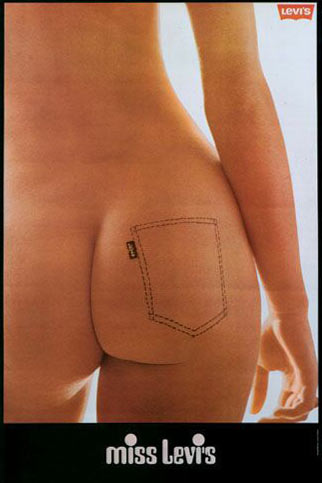
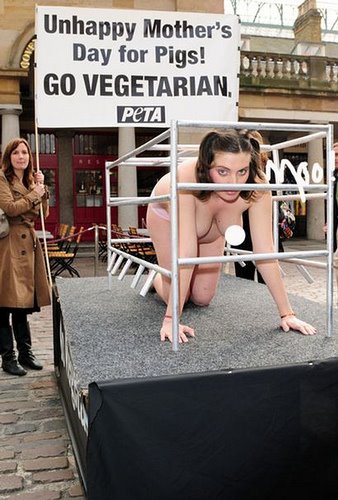
"Sex sells". When it is not selling me pants, sunglasses, bikini waxes, and a fat-complex it is now selling me morality. Take away the message and what is the difference between an ad like this and one like this? The answer is absolutely nothing. Naked women have nothing to do with Levi's pants or vegetarianism. The message, "this lifestyle promoted in this ad is sexy", does not vary between the two ads. The only difference is that one lifestyle is that of buying jeans, and the other is the lifestyle of not eating meat.

We humans must be incredibly stupid to fall for such shoddy marketing. I really have no words for a society that buys cheap body-spray en masse when the half-wit marketing experts at the firm have nothing more to say for their product other than it makes women take off their bras. How does it do that? Nobody knows, simply because there is a cognitive dissonance when I try to compute a reality in which people are convinced to buy a product on the promise of sex that it cannot possibly deliver.

Axe Body Spray is hardly the worst offender. Axe promotes no political agenda other than the dudely enjoyment of foul smelling cologne masking the fact that you have not showered in a week, or the simple-minded pursuit of titties. This ad campaign works, I might say, because the people who would use cheap cologne to excuse not taking a shower would be the kind of dupes to connect buying something with getting laid.

Liberals, however, claim to function on a higher level. Empathetic beings concerned with the plight of life everywhere do not need bared breasts and toned asses to buy, or not buy, a lifestyle.

Wrong.

Guess what bikini models have to do with the suffering of chickens? Absolutely nothing. If PETA really wished to highlight the suffering of animals, they would make their protests horrible, frightening, and sickening. With so shortage of horrifying images of animal suffering (five minutes of googling produced this, this, this, and this) why does PETA, among other organizations, feel the need to sell the idea that animals are suffering for our lifestyle with sex?

Melanie B, from the Spice Girls, would also like you to know that Sex Trafficking is hot. "Get your tits out for trafficking!" an activist asks us. We all know that strippers and prostitutes always get the best side of the law, because society as a whole values their opinions and personhood so much. Making our causes into our pimps and baring it all for a liberal cause, of course, wins the respect of many. It is also very relevant to the discussion at hand. Animal abuse and the unwilling trafficking of sexual slaves in our own country is titillating and sexy.

PETA reminds me of a circa-1970s Al Sharpton, who shot himself and his cause in the foot by involking the ire of New York Jews with some insensitive antisemitic remarks. To this day, Sharpton and his pose of goons continue to give activists a really bad name by various other classy shenanigans such as sexism and rape apology. Of course, the average American can tell you that he or she thinks Sharpton is full of shit. He or she will place Sharpton in the "bat-shit crazy" category alongside PETA. The most damaging person to their causes, obviously, is PETA activists and Sharpton themselves. The average American is not convinced. Thus Sharpton and PETA are unsuccessful.

In contrast, anti-abortion activists continue to get considerably more positive press than PETA. The reason why is not rocket science. Perhaps it is because their ad campaign is so blessedly simple and horrifying. I am firmly and absolutely pro-choice. However, I will say that if I had no opinion on eating meat or abortion, the anti-abortion ad would be significantly more morally compelling than a strip-tease for animal rights.

There are only two rules to good advertising: keep it simple and relevant. The anti-abortion ad is a picture of an abortion, thus it is relevant. It just states, "abortion is bad". The PETA ads, however, are convoluted and self-defeating. Alicia Silverstone with no clothes on does not really have anything to do with my greasy hamburger. The PETA ad asks the viewer to make a connection between nakedness, fur, and animal cruelty. The connection is tenuous, and thus, falls apart. The abortion ad achieves its purpose while the PETA ad does not.

Not only does PETA need to fire its marketing executives, the organization itself is probably the only thing on the planet more self-defeating than Al Sharpton. Commenters will poo-poo my critique all they want, but the fact remains that feminists can be agents of their own oppression especially when they sell their bodies for a cause that has nothing to do with sex. Yes, the woman who climbed into a cage while naked and pregnant in the cold to protest animal cruelty did so consensually. Would she, however, have posed nude if female nudity was not the biggest successful seller of unnecessary over-processed shit on the planet?

In conclusion, I hate PETA, and will continue to do so because:
(a) They utterly fail at marketing
(b) They protest the cruelty of animals with the objectification of the female body
(c) They diminish the horror of their cause with meaningless strip teases
(d) They diminish and poo-poo the objections of activists for other causes
(e) They are the most unintentionally self-parodying group on the face of this Earth

I will not continue to suffer any fools, especially sexist fools that sit on their high-horse naked and defeat feminism's basic tenements in order to diminish the real issue of the objectification of women, and to sexualize the suffering of animals.

Note: As the author of this post, I will delete comments that are trolling, offensive, and off-topic, and ask that all contributors to this tread ignore all those who will attempt to hijack the thread.

Note 2: After only having this thread open for three hours, I am closing the comments due to the thoughtless, rude, and asinine trolling of one Coyote Skinhead, self-proclaimed "critical thinker" and anti-feminist.

Note 3: Thank God for the ban-hammer. Comments on this post and some of my others will go back on, now with moderation. Thank you internet, for imposing moderation upon us by providing the world with anti-feminist trolls.
Wednesday, April 2, 2008

My Feminist Flashback: Action Project

In the first women's studies class I ever took (Fall of 2007), students were required to do a group "action project" as part of their final grade. The project could cover any issue that had been discussed in the class, and Kate (who was also in the class) and I teamed up with another lady for this assignment.

Our topic: the media's effect on body image.
Our goal: to raise awareness of the fact that the media is constantly bombarding people with messages about what is beautiful, and get people to discuss the effects that can have on people's body image.

We focused mainly on one medium, magazines, and our tactic was to pull out advertisements (which make up a large part of most magazines) that portray messages of beauty or attraction and post them on the walls of the Human Rights Center, a building on campus where human-interest clubs meet and hold events.

Here are some pictures of our work (Kate took all the pictures with my camera).


The pictures above show just some of the images we found. We had a decent sized group that attended our event, and we had a pretty engaging conversation about why magazines use the imagery that they do and how it can make people feel. It was interesting to note that most of the appearance motivated ads feature white women.

Sunday, March 9, 2008

Anti-domestic violence ads

These ads are powerful commentaries on domestic violence. Please view them, and click for a larger image.

thanks.

Thursday, March 6, 2008

Vintage Sexism

This ad was sent to Kate during our radio show today. Her sister found it online. Circa 1953.


Because, you know, sometimes those darn ketchup bottles just require a man's touch...