Showing posts with label Children. Show all posts

Tuesday, January 18, 2011

Gay Parenting Most Common in South

This article is very interesting and enlightening on a number of levels.

In addition, the data show, child rearing among same-sex couples is more common in the South than in any other region of the country, according to Gary Gates, a demographer at the University of California, Los Angeles. Gay couples in Southern states like Arkansas, Louisiana, Mississippi and Texas are more likely to be raising children than their counterparts on the West Coast, in New York and in New England.

The pattern, identified by Mr. Gates, is also notable because the families in this region defy the stereotype of a mainstream gay America that is white, affluent, urban and living in the Northeast or on the West Coast.

“We’re starting to see that the gay community is very diverse,” said Bob Witeck, chief executive of Witeck-Combs Communications, which helped market the census to gay people. “We’re not all rich white guys.”


My first reaction is to hope that the fact that the South is home to the most gay parents will serve as a wake up call to residents of other states that consider themselves progressive but aren't forcing their state legislatures to make a real push for gay rights (I am looking at you, New York). What are your reactions? What stood out to you about these findings?

Tuesday, August 10, 2010

Speak up and expect to be dismissed, petulant child.

(cross-posted from Feministe)

The past few months of my life have made one thing startlingly clear: At 21 years, I am too young to be taken seriously by some people who are older than myself, and quite frankly, it’s beginning to piss me off.

I am not the type of woman who has ever been able to watch injustice unfold and do nothing. I often confront people who I believe are acting in hurtful ways because I hope that people would do the same for me so I could learn from my mistakes. In fact, that is the only way I ever have learned much.

I have stood up to people older than myself and this has almost never turned out well.

Start with Situation #1.

My hometown is a small place, and unfortunately, it is not very open-minded. This town is not often outwardly hostile, but I have never been comfortable with the bigotry displayed by many individuals there.

A few days ago the ex-fire chief updated his Facebook status, wondering if a type of deodorant was for men or for women. I saw this as a good opportunity to voice my opinion that if he liked it, I hoped it wouldn’t matter gender it was “meant” for. My comment was immediately followed by another grown man from the community saying that I must have meant that it was ok for the poster to be a “homo.”

I immediately commented back to clarify that I had meant nothing of the nature and that using the word “homo” as an insult was offensive and hurtful.

This man never acknowledged my words and instead took to making fun of me. Eventually another woman commented and told me that using “homo” as a type of insult in this instance was not offensive because the person being called the “homo” was not offended by it. I replied that just because the person being insulted wasn’t offended doesn’t make the use of the word any less hurtful and that excusing this behavior was problematic. I was then told off by that woman who called me “sweetie,” said I knew nothing about her, and that God would be the final judge.

It was the “sweetie” thing that bothered me the most, because with that languge, the kind that is usually used to address children, it was blatantly clear that she was through listening to me. She had already made up her mind that I had nothing worthwhile to say. Turns out I was right about this.

Annoyed and feeling as if this woman had a completely false idea of what I was trying to accomplish, I sent her a private message offering to talk in detail. She made it clear that she did not feel a discussion with me would offer her anything, an attitude which she indicated through her constant claims that she has more “life experience” than I do, and the fact that she has attained higher levels of education.

Now, on to Situation #2.

At the end of June I attended a meeting for queer youth. At this meeting, there was a misunderstanding between myself and another female attendee that ended with the woman getting very upset and leveling several insults at me, including one about my personal life that was completely irrelevant to the current situation. She then stormed out of the building.

A few moments after she left, the man running the meeting turned to me and told me, in essence, that it was my fault that she had verbally attacked me. He then got up and started doing some light cleaning. This act of silent approval of the woman’s behavior left me feeling attacked and without an ally at this meeting, a feeling that prompted me to leave and not return that night.

So a few weeks later I messaged this man on Facebook (as I was without a phone). I explained how disappointed I was with his behavior, how he had made me feel unwelcome, and how I felt that it was inappropriate for him to place the blame squarely on my shoulders when I was the one who had been attacked.

He responded that I should come back and see him if I wanted to have this discussion, which was fair, but I explained that in my current situation, I had no transportation. He told me that was my choice, and I said I was disappointed in him not trying to work something out with me. He responded:

Your inability to to get or find transportation is no concern of mine. You want to be treated as an adult, then start behaving as one not as a petulant child.
This was the end of our correspondence, and it left me incredibly ticked off. Not only did I feel that my words did not warrant such a critical response, but he was completely dismissive. Not once did he acknowledge what I had said, or give any sort of idea that if I were to find a way to meet with him that he would acknowledge what I had said. He kept things on his terms until he decided to end our correspondence. That’s the problem in both of these situations.

Both of the people mentioned above are twice my age and both of them clearly had problems with me, but not outwardly so until I challenged them on their behavior. However, while I’ve been sitting on this post, I’ve tried to put myself in their shoes because I feel that that is only fair, and I think I can relate to them to some extent.

It’s difficult and uncomfortable to be challenged by people who are strong in their convictions, no matter their age. It makes me feel insecure about my own ideas and beliefs when this happens to me. It must be especially difficult when the person challenging you is much younger because I know that most people who are much older than me tend to be of the mind that children are not supposed to question their parents or authority in general, so when this role of submissive child is broken, I can imagine it being shocking. And maybe this shock is why these two people spoke down to me when I voiced my criticisms.

However, this dissmissing of my ideas based on my age leaves a big problem. If people set some arbitrary age until which they will not take people seriously, they are missing out on many opportunities to learn valuable lessons. People of various ages and life experiences (and I do not buy into the idea that just because someone has been alive longer that they have more “life experience” than someone younger) will bring very different ideas about how to solve problems, and it is that kind of melding of ideas that is most likely to come to practical and workable solutions. But it also requires that people want to listen to others who may not agree with us or may be younger than us.

I am open to the idea that perhaps I could have handled myself better in these situations, and I have been giving this some serious thought. Should I not have said anything? Would these people have been more receptive if I had sugar coated my criticism? Would they have taken me seriously then? Will people who perceive me as angry (rightfully or not) ever be able or willing to truly listen to me?

All I know for sure is that I did make every attempt to express myself firmly but not impolitely. I know that what I had to say was not going to be easy to hear, but I tried to say it in the least offensive way possible. But my attempts were met with dismissal and cruelty. Neither of these people seemed to have listened to anything I said. Their behavior was, as they made clear, largely based on my age.

These people that I have been bumping heads with are hiding behind the idea that their years give them experience that no idea in my head will make up for. None of my thoughts or my own experiences mean anything simply because these people have been alive longer and, in their minds, know better. This is extremely frustrating because it makes no sense. Dismissing someone based on their age and supposed lack of experience is easy, but it is harmful, too. If we cut people out of our lives by believing they have nothing to teach us, how much can we really know about the world we’re living in?

Saturday, July 31, 2010

Children are people, too.

This post was prompted by a line in my post entitled "Toddlers are not grown women" in which I said:
I also believe that parents should play a role in helping their child make decisions and that they should view their child as a partner in this regard.
In the comment section of that post, Anonymous challenged my idea that children could or should ever be viewed as partners with their parents, suggesting that parents' roles in their children's lives should be that of "bosses" who make decisions for children because they are not capable of doing so on their own until adulthood (which I read to mean legal adulthood, suggested by this commenter in another comment that was not posted due to its tangential nature, to mean 18 years of age).

Anonymous said:
Raising kids by being their "friend" results in horrible, maladjusted kids with a lot of selfishness and problems.
First of all, nowhere in that post did I suggest that parents should act as their children's friends. I do not even suggest that children should be viewed as completely equal partners with their parents. All I meant to suggest was that children should be viewed as more than objects to be controlled by their parents. I'll expand on that idea here.

I'd like to clarify that I do not have any children. However, I have experienced a type of parenting that I would not want to replicate if I ever had the desire to raise children of my own. In the middle class, white American culture I grew up in, there is an overarching idea that children have little capacity for personhood. They are treated like objects or pets that should be, in essence, ruled over by parents who always know what was best for their children, without question. Children's opinions and desires do not matter because of their age. In effect, children are lesser people, if they can even be considered people at all.

I have a huge problem with conceptualizing children in the same manner as one might think of a pet. I do not believe this mindset is healthy for the parent or the child. It has the potential to create dependence in children that may make it difficult for them to take on "adult" responsibilities once they reach legal adulthood and it presents a way for parents to place on their children an unfair burden - the responsibility of making their parents feel useful. When the roles of parents and children change as children grow up, it cane be difficult on everyone.

I believe that this idea that children just are not capable of doing certain things is, largely, due to socialization. If parents treat children as if they are incapable of making any decisions at all (as opposed to only life-altering ones), children will not have to rise to the occasion and will fill their parents' low expectations. If parents expected more out of their children and viewed them as capable of doing more, I think a lot of people would be surprised by how much children are capable of.

I also want to stress my belief in parents' roles in helping oversee their children's decisions and helping them navigate the world while teaching and disciplining when necessary. However, allowing children appropriate amounts of control over aspects of their lives is important because no person, small or not, should be ruled by someone else who denies them the opporunity to exercise any amount of power over their lives.

This acknowledgement of a child's personhood throughout life (as opposed to waiting until a child reaches some arbitrary age) could easily create more independent children who are better equipped to handle "adult" situations and responsibilities without doubting themselves. Treating children as smaller people could also easily create within the minds of children reasonable expectations of respect. When they are not used to thinking of themselves of subjects under their parents' rule, it might be easier for them to fight for their rights and perhaps even those of others when they finally leave the nest.

Thursday, July 29, 2010

Toddlers are not grown women

I was watching a clip from the Colbert Report when I first heard about Baby Gap's line of Mini Skinny jeans. Yes. Skinny jeans for toddlers.

Below left: A screen shot from the Gap website of a white female toddler (labeled: "hayden, 3") in what appears to be a denim jacket and fitted "Mini Skinny" jeans. Her hand is to her mouth.

Now, I believe that children are people and should be allowed, when able, to decide what they want to wear. I also believe that parents should play a role in helping their child make decisions and that they should view their child as a partner in this regard.

The reason I have a problem with skinny jeans for toddlers is that they're taking a fashion trend originally meant for grown women and making it into something to be owned by children. Skinny jeans are no more practical than other jeans for toddlers. This is a blatant rip off of grown women's clothing - and guess what toddlers are not? Grown women. And treating them as grown women by dressing them up in clothes that look like those worn by adults creates some potentially disturbing possibilities.

This ties back to the trend of sexualizing women at younger and younger ages. While these jeans are not sexual, they are meant to model toddlers after adult women. That is a problem.


Edited to include a caption for the screen shot I included. Also, check out Gap's "Boyfriend jeans" for toddlers (thanks to Anonymous in the comments for the heads up about that!).

Sunday, July 18, 2010

You're a woman. Now make some babies!

This post was inspired by several posts over at Shakesville regarding the idea that women who choose to remain childless are selfish. I agree with the commentary at that blog, so I recommend you check it out.

The idea that deliberately childless women are selfish is a general theme when it comes to policing women in this society and smothering them with ideas of what other, more important people expect them to do with their lives as opposed to allowing them to make their own decisions without comment. When a woman, especially a married woman, chooses not to have children, it opens her up for all sorts of comments ranging from her being selfish to the idea that she must be very unhappy because she doesn't have kids.

And in
this piece about men who really really want to be daddies, the wishes of men are added to the mix of reasons why women should feel terrible if they do not reproduce as society (and perhaps their husband) expects them to. (Trigger warning on that link for descriptions of reproductive coercion)

According to this piece, there are a growing number of men who desperately desire to be fathers, but are hitting roadblocks because the women they are with would rather do things like pursue careers, or they just plain aren't interested in being mothers. The disturbing part of it all is that it shows that some men want to be fathers so badly that they will pressure their wives into trying to get pregnant.

Take Neil, whose wife Fiona was made a partner at a PR company and does not feel ready to be a mother. Neil said:

"I'm putting pressure on her to stop taking the Pill and to leave the situation to fate," he admits. "I know it's a decision we've got to make together, but I don't want to be an old dad. A baby would make my world complete."
There is a sad but interesting point here. Evolving gender roles and opportunities have allowed more and more women to progress in careers that they may not be willing to give up right away to start a family. They have also allowed men to express their desire for fatherhood more openly. While that may seem like progress, where women used to be forced to follow husbands pursuing careers, they are still facing opposition to living the lives they want from husbands who are willing to coerce them into having children to fulfill their own desires.

It's great and all that men are coming around to the idea of fatherhood and that they don't have to be alienated from their feelings when it comes to wanting children. But women should also be allowed to be true to themselves, whether or not their visions for their futures include children. They shouldn't be ridiculed or looked down upon for not fitting into other people's expectations. All in all, women still lose.

I guess this whole motherhood/children thing has been on my mind lately because of the unsettling trend among girls I went to high school with of getting pregnant and married before they turn 23.

I'm relatively young, but I have known for most of my life, with much certainty, that I will never be a mother. Children tire me. I have never been able to stomach babysitting for more than a few hours at a stretch. Holding babies makes me anxious, and I have several memories of being a child and family members practically forcing me to hold a baby, a new member of the family, because why shouldn't I want to hold a cute little baby? The thought of being responsible for a human being, emotionally, financially, what have you, terrifies me.

When I've expressed these feelings to various people, generally my family, it has been said that I will change my mind once I grow older. You know, right about the time that this society will start expecting me to pop out some babies and fulfill my womanly duty of self-imposed motherhood.

Not to mention my type 1 Diabetes and the difficulties of managing the disease with another human growing inside me and the potential complications that could arise from that. Not to mention the obvious idea that me parenting a child that I did not want to be a parent to is the ultimate form of unfairness. Not to mention that with those things taken into consideration, I might sound like a good person who has made the right choice when it comes to bearing children.

But that's not what people will see when they look at me in a few years and ask if I have children. Or if I want them. All they'll see is the word "Selfish" stamped across my forehead. Unfortunately, as long as women continue to be necessary for creating babies and as long as we live in a society that believes that arbitrary expectations are more important than the desires of individual women, it's a brand that many of us will not be able to escape.

Tuesday, April 6, 2010

A lunchtime conversation among friends

Overheard at the lunch table today...
Boy 1 to Girl 2: I heard Girl 1 didn't like a princess when she was at your house!

Girl 1: I didn't like Jasmine when I went over to your house.

Girl 2: Why not?

Girl 1: Princesses wear long skirts. She had pants on.

Girl 2: Princesses can wear pants.

Boy 1: Yeah, princesses can wear pants!

Boy 2: They can even wear shorts.

Girl 2: Yup.

Girl 1: They could wear underwear outside!

Girl 2: Nope, princesses don't do that.

Boy 1: [mashes up watermelon in his milk glass] Look, I made a watermelon smoothie!

The end.

Thursday, March 11, 2010

4 year old hate speech

(trigger warning - language)

So.... one of my 4 year olds called another a faggot today.

In case you don't know, I work in a preschool, one that has a mission statement of specifically empowering women and girls.

We had just come in from playing outside and were taking off snowpants and boots, about to head to lunch. I don't even know what happened in the build up, but it came pretty much out of no where.

I didn't catch the first part of what he said, but he was talking to another girl. He ended the comment with, "faggot!"

I said, "What did you say?"

He said, "faggot?"

"No. That is not ok. You can not use that word. It hurts people," I said.

"I can say it at my house!"

"Well, this isn't your house and I don't want to hear it."

"[brother] says it!"

"And if he were here, I'd tell him the exact same thing."

"Aw, come on, can't I just say (mouths faggot) one more time?"

"No! I don't want to hear it again."

I usually don't respond to kids swearing. Most of the time they're just trying to get a reaction from someone and it's easiest to let it rest. Often, another kid will tell me another kid swore and I just tell them to tell the offender that they don't want to hear it.

I think I was just so surprised that I instantly responded. But even so, I wouldn't have let that one pass. I responded with emotion, I think more emotion than the kids are used to me wielding. It's just ... these are 4 year olds. Faggot should not be in their vocabulary.

There are several open lesbians who work at my site, several of whom bring their partners to school functions. His mother works at the site and he has spent the night over at one women's house many times.

I don't know if he knew what it meant. I doubt it. Would he have used it if he knew what it meant? I don't know.

He did know that it wasn't something nice to say.

He did know that you're supposed to say it in a mean tone, spitting it out of your mouth like venom.

He did know that it was a name you use when you want to make someone feel inferior, like shit, to show that you're better.

He knows it's supposed to hurt. Which means that it doesn't matter if he knows what it means, because he'll use it again as a weapon. Except next time, I won't be there.

Thursday, February 11, 2010

When someone says no, you have to listen.

As someone who works with preschool children, I'm often very deliberate about the things I say. I make sure every rhyme is pointed out, every letter that corresponds to someone's first name is traced, every opportunity for something new is used.

I've increasingly become very deliberate about the words I use when talking about behavior as well. I find myself repeating things like "When someone says no, you have to listen" and "Ask before you touch your friend." Sometimes my language is prompted by the language they use - if someone is complaining about hitting, then we talk about nice touching.

I do it because I want this language embedded in their vocabulary. I explicitly use no in this context because I want them to feel comfortable saying no (especially to their friends) and that when someone says no, it's respected.

I want them to know that you can't just touch another person's body without asking. One of my rules is that a kid has to ask before sitting in my lap. Partially, it's selfish. My legs get tired and fall asleep with too many kid bodies on them. But there's also that idea that my lap is mine alone and I make the decision if I want someone to sit there. If a kid walks up and sits down without asking, I make them stand up and ask me if they can sit there. Sometimes I say yes; everyone's happy (unless there's another kid competing for the lap. Long story). Sometimes I say no and suggest that they can sit right in front of me.

I'd like to think that these things stick with them, that they'll remember that they have to listen to another person's no. The unfortunate part about early childcare is that a lot of times, these kids won't remember us. I don't remember my preschool teachers. That's why it's so important that these basic concepts of bodily sovereignty are maintained from year to year.

I only hope that my no and respect for a no is remembered and thought of when they hear no again.

Monday, January 4, 2010

Touch, Children and Consent

I've mentioned before that I work in a preschool. It's incredibly fun and I love my specialized focus of teaching my 3-5 year olds the necessary literacy skills they'll need to be successful readers in kindergarten (Psst: If you live in Minnesota, love working with and teaching kids, and need a short-term [1-2 years] job for next school year, email me and I'll give you more information about my non-profit).

However, once I'm with my kids, it's like my body is not my own anymore. More specifically, my lap for sitting, my hands for holding and rarely my hair for pulling. This is usually the extent of it, but occasionally kids will ask me what my breasts are or touch my butt from behind without notice. It usually doesn't bother me (except the one time when a kid had messy hands from lunch and wiped them all over the back of my jeans).

Today while reading The Lorax, one of my students began putting her hands near my collarbone, resting them on my skin for a moment then moving them to my other side. She said she was checking for my heartbeat. Another boy stuck his hand out and put it squarely on my breasts, saying, "No, this is where her heartbeat is." I suggested they try checking for their own heartbeat underneath their chins, modeling how to do it. His touch obviously wasn't sexual, but there's still something jarring about being touched, especially in some areas, without notice or consent. I don't want to stigmatize a particular area of their bodies as sexual, dirty, shameful or something they shouldn't be touching without the larger context and conversations of age-appropriate bodily education.* But they know the rules - hands to yourself, you must ask a friend first before touching, and you have to listen when a friend says no.

Awhile back we got a new girl in the class. She had no troubles adjusting to the class and got along well with the other children. On her first day, one of the boys suggested they be boyfriend and girlfriend. They held hands a bit during story time (with several warnings about the hands to yourself rule) and he tried to kiss her on the cheek after. She clearly didn't like this and I had to tell him to respect her no, even if he didn't like it. The class rules say that we have to listen to everyone's no, but I felt like I should have included that a girl's no must especially be listened to. It turns out she didn't even want to be his "girlfriend," but felt a little pressured. I told her that it's ok to say no if you don't want something. Again - these are 4 year olds.

But it must be said early and often if the message is to be understood.

Sometimes I wonder how I would do my job if I had difficulties with being touched without asking or were triggered by such actions.

Yet at the same time, I have to consider my own actions. Sometimes I touch kids without expressly asking. In the case of some kids, it helps if I rub their back during storytime. They listen better; they keep their hands to themselves, and I imagine it makes them feel loved. At first I finished that sentence with safe - I imagine it makes them feel safe- but I don't think I can say that for all kids. We want preschool to be a safe enviornment and actively work to destress kids in order to make them feel comfortable enough to learn. Some kids like having their back rubbed or scratched and I suppose I just think most kids like it.

And then I read Rebecca from City of Ladies and Thomas from Yes Means Yes** and step back to evaluate my own actions. Am I touching kids who would rather I not touch them? Perhaps. There are some things I'm very explicit about - I always ask a child if they would like to give me a hug and accept the occasional "no." I don't take pictures of children without their consent. But it seems that I must adjust my actions to include all touching if I am truly to respect their own decisions about their bodies.

It only takes a quick "Can I rub your back?" and all bases are covered. How many difficulties in this world would be avoided if only we checked in and made sure we had consent first?


*Since this came up a bit in one of my prior posts about preschool children and the language they use to describe their bodies, I'll state this clearly: I believe in age appropriate bodily education and will implement this in the classroom. That doesn't mean, as one anonymous commenter suggested, "feminists teaching [preschool children] about their bodies or sexuality." Age appropriate bodily education includes proper, anatomical names for body parts (arms, legs, brain, arm bones, vagina, penis, toes, etc) and recognizing what their bodies are telling them (hunger, sickness, anger, happiness). I'm not indoctrinating kids into feminism when I say that I use age appropriate bodily education; I'm teaching them that sometimes that funny feeling in their stomach means they're hungry, angry, sick or have to poop.

**My own thinking on the topic of children and bodily respect has been influenced by Thomas' post "If She's Not Having Fun You Have To Stop." It has been useful in shaping the way I interact and help police my student's actions.

Monday, December 21, 2009

Fat acceptance for 4 year olds

Today while reading a story with one of the PreK students I work with, she stopped me in the middle of the book to ask me a question.

"Am I fat?" she asked.

"No." I said.

"Am I skinny?" she asked.

"You know what?" I said, "Everyone looks different. And that's ok. Do you look the same as me?"

"No."

"Do I look the same as (another student)?"

"No."

"Does (another student) look the same as (another student)?"

"No."

"We all look different. And that's not bad. It's good. It's ok that we all look different."

And then we started talking about the different ways we get to school in the morning and how she wanted a bike for Christmas.

Now that I've had the chance to think about our talk, I wonder if I wasn't clear enough. If I didn't state explicitly enough that she is wonderful just the way she is. If I could have made her understand that her body is her own, to be judged by no one. If I should have used words like acceptance and love instead of different and ok. If when the other teacher called her "our big girl" and told her not to eat quite so much, I should have done ... something. Anything.

My student is 4 years old.

She is facing a lifetime of societal messages telling her to be thin, white, blonde, tall, physically able and more from every angle, explicitly and subconsciously. Already my students dress up as Belle, Cinderella, Sleeping Beauty and other princesses that don't look like them.

Since the outside forces of society are so strong, should I have been explicitly clear that her body shape does not define her? That there are more people who don't look like Cinderella than do? That the standard of beauty is constructed to be impossible? How can I use my limited role in her life to help her accept herself?

My student is 4 years old and asking me if she's fat. How can I ever do enough to help her?

Wednesday, November 18, 2009

Butts, penises and cookies

I submit, for your consideration, exhibit A in the case of needing accurate age-appropriate education about our bodies, a scene from the PreK classroom where I work:

We are reading a book about how dinosaurs say good night. One of the dinosaurs turns off the light with his tail.

Lead teacher: Do you turn off the light with your tail?
All kids: No!
Boy: We don't have tails! We have butts and penises!
Girl: Girls don't have a penis! We have cookies!

There's a split second where everyone looks at the boy, then the girl, thinking we're going to tell them not to say "penis." My lead teacher says, "Girls have vaginas," and keeps reading.

At least the girl didn't call it a vah-jay-jay.

Sunday, July 12, 2009

Swedish couple decides to keep their toddler's gender a secret

Since I began identifying as a feminist, the idea of gender and its implications has been a growing fascination of mine. In my readings (for classes, blogging, and other research) I have learned about how socialization can lead to boys and girls have very different ideas about everything from toys, to food, sex, and even life goals. And that says nothing about the concerns faced by individuals who do not fit comfortably in the often-problematic gender binary.

When I read this piece from The New York Times website about a Swedish couple that decided to keep the gender of their toddler a secret, I was really interested.

The toddler's mother is quoted as saying:

“We want Pop to grow up more freely and avoid being forced into a specific gender mould from the outset,” Pop’s mother told the Swedish newspaper Svenska Dagbladet last spring. “It’s cruel to bring a child into the world with a blue or pink stamp on their forehead.”

The piece then quotes Anna Nordenström, a pediatric endocrinologist at the Karolinska Institutet, as saying (emphasis added):

“It will affect the child, but it’s hard to say if it will hurt the child,” says Nordenström, who studies hormonal influences on gender development.

“I don’t know what they are trying to achieve. It’s going to make the child different, make them very special.”

She says if Pop is still “genderless’” by the time he or she starts school, Pop will certainly receive a lot of attention from classmates.

“We don’t know exactly what determines sexual identity, but it’s not only sexual upbringing,” says Nordenström. “Gender-typical behaviour, sexual preferences and sexual identity usually go together. There are hormonal and other influences that we don’t know that will determine the gender of the child.”

I think that Pop's parents are trying to be proactive about the problem that gender often presents. Granted, I have not studied hormonal influences on gender development (and I'm not even sure I believe there is much of an influence), but I think that these parents should be given a lot of credit for trying to take this matter into their own hands instead of giving their child up to a gendered society that often works to limit the abilities and opportunities of people who are not gendered as male. Even if Pop is biologically male, I can see many benefits for the child not growing up gendered in that way.

What do you think?

Wednesday, February 18, 2009

Sex + Texting = Sexting

Newsweek had an interesting column this week about "sexting" the semi-clever name for sending naked pictures via text message. A study claims that 1 in 5 teenagers have "sexted." (The study specifies that 22% of girls and 18% of boys have admitted to "sexting.") The column talks about how many of these teenagers are being legally prosecuted for their actions. Both the senders and recipients are being charged: the senders with "production and distribution of child pornography" and the recipients with "possession."

The column focuses on the absurdity of punishing children:

"The argument for hammering every such case seems to be that sending naked pictures might have serious consequences, so let's charge these kids with felonies, which will surely have serious consequences."

I agree completely.

When I was a senior in high school, a freshman girl texted another student a naked picture of herself. The boy forwarded it to his best friend, who then sent it to most of the school. The principal became aware of the situation and ended up kicking the girl off of her sports team. The girl later transferred. The boys who had forwarded the photo weren't punished.

Parents are outraged at this trend, of course. They should be. The Internet's memory is infinite, and text messages are easy to forward. So why are thirteen year olds taking naked pictures of themselves? Teens are not stupid. They know that these phone photos will be forwarded and likely end up on the Internet. I am willing to bet many of these young people do it hoping most of the school will see it. Teens know that nudity is a type of capital. They see failing musicians pose for Playboy and then hear their music on the radio. Or they watch Tila Tequila, a woman with little talent and few clothes, get a television show. Popularity and being a known as "sexy" in high school is the equivalent of an MTV show, and one photo can be all it takes to become "someone" in high school. Everyone at my school knew about the girl whose photo was forwarded. Some boys even put the picture up in their locker, next to Pam Anderson or Adriana Lima.

This trend is going to continue because the reason kids "sext" is not going anywhere. When students value popularity and a label above anything else, they will do anything to get it. The consequences, like the permanence of the Internet, don't matter. We need to give these girls something more to strive for.

Thursday, July 10, 2008

On Staying Single

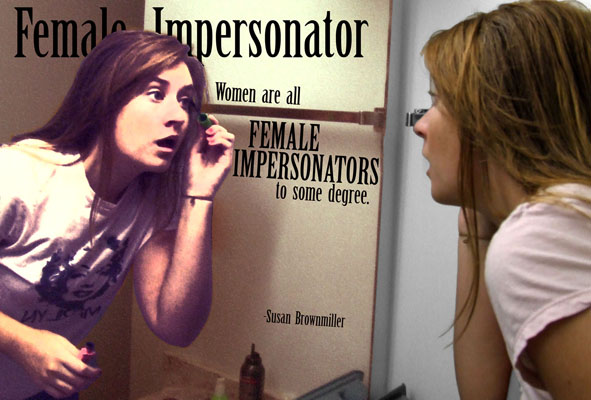
Notice that I am not just single currently, but that I am  staying single. This was not a conscious decision. I did not sit down one day, feminist ideology in hand, and decide to stay single for political reasons. It just happened. I haven't been in a relationship for two years. For a woman in her twenties, this is so odd as to be alien.

When I was in middle school, nothing could have been more important than being in or wanting to be in a relationship. Boys were just beginning to notice me, probably because I was one of the first girls to have her breasts grow beyond the mosquito bite phase. Luckily for me, I did not grow up in the Paris Hilton era. Britney Spears was still keeping most of her clothes on the late 90s when the pre-teen girl uniform of choice was polo shirts, short shorts, and high ponytails.

Regardless, my desire for a boyfriend and to look good had nothing to do with my sexual desire. Although I had curves and breasts to rival any grown woman, my sexual drive had not matured. I heard about masturbation, mostly from the eighth grade boys, but such things held no interest for me. Even the extremely progressive books on puberty that my parents bought me detailed male masturbation explicitly, although some of them spend a bit of time on female masturbation as well. Curious, I attempted this masturbation a couple of times. Nothing really much happened, presumably because my sexual drive had yet to develop (it would in high school), so I gave that up.

Why then, was the pinnacle of pre-teen social life the drive to attract boys? I obviously did not know what to do with them when I got them, and I had no sexual desire for them. I was putting on a performance, plain and simple. The dominant social message of the time, and I assume it has gotten worse lately, was that a girl should aim to look sexy and have sex, but her own enjoyment of the sexual act had nothing to do with it. This held true for my twelve year-old self: I was not attracted to boys in a sexual manner, and I had no personal desire for sex. I was simply responding to social norms. If I said a boy was cute, it was not the case that I was attracted to him. I simply recognized that he fit within the acceptable range of male appearances, and I wanted him to want me. My desires did not play into the equation at all.

As I moved on from middle school and entered high school, my sexual drive finally blossomed. I had a healthy desire for sex and masturbation by the time I was fifteen. Still, however, I cannot think of a time that I wanted a boy more than I wanted him to want me and the social power I would gain by being sexy and attached to a suitable male. I was also doing battle with my monstrous crush on my female friend at the time by denying to myself that I probably was not as straight as I would like to be. Nevertheless, the idea of a boy competing for me or spending time on his appearance for me was laughable. By the time elaborate hair and makeup routines were the norm for girls my age, boys had yet to grasp the concept of showering daily.

Simply put, being sexy was more important than being sexual. The conflicting messages of abstinence and MTV had done battle, and the result was "be sexy, be hot, be available and wanted. Your sexuality is shameful." It was not important that boys were attractive, and they largely were not, it was important that I was attractive to them. Due to my extremely extroverted personality and unwillingness, even then, to play weak or dumb, I never succeeded.

In college, the drive to be wanted and not to want became funny in its intensity. The antics of my peers inspired mental images out of a porno: buckets of male ejaculation everywhere, but no elusive female orgasm. Men were still boys, and still had not grasped the basics of hygiene that were common sense to the average eleven year-old girl. And why would they? All around them women were wearing next to nothing and viciously fighting for their attention with deeper tans, deeper v-necks, and higher shoes. All they had to do was sit back and enjoy.

After a disastrous series of boyfriends where the male orgasm was far more present in our relationships than the female orgasm, I had the luck to fall into Feminism by way of a Women's Studies course. Among the considerable changes in my life, I stopped wanting men to want me if I did not want them back.

Simply, if my sexual pleasure had no part in the equation, I wanted nothing to do with men. If they were not attractive, their attention was gross and creepy. It was surprisingly easy to find my dry spells becoming longer and longer, only broken up by my mostly pleasurable forays into lesbian relationships.

How was this so? Once I gave up performing the sexy routine, guys largely did not want me. Which was fine with me, because most guys my age hadn't touched a razor or bar of soap in half a week. My university was like a scene out of a pornography: most of the women were conventionally attractive, but the men were as lazy with their appearances as they were with their health.

Today, I find it pathetically funny how my pursuit of my own pleasure--wanting attractive men, wanting sexual fulfillment--removed me from the dating scene. By raising my standards to men that I wanted, instead of men that wanted me, I had to find men that spend a comparable amount of time on their appearance and would be invested in my pleasure as much as their own. Unsurprisingly, the men who spent as much time in front of a mirror as I did (which wasn't much, considering that I stopped tanning and wearing large amounts of makeup) were the ones that dated the most feminine women, who had the personality of swine, or who were more interesting in acting out their favorite pornography than pleasing their significant other.

What I realize today is that the dating scene revolves around male pleasure. Male orgasms, male lust, male appreciation of beauty. If I wanted female orgasms, my lust, and my appreciation of male beauty I was holding out for something that did not exist. Or, if it did, it was not available to me once I stopped tanning, obsessing about how flat my abs were, and wearing hundreds of dollars of makeup.

In conclusion, I stay single because it's pathetically easy, but not by my design. Perhaps one day I might stumble upon a man who is as invested in looking good for me as I would be invested in looking good for him. Instead of me wanting him to want me and him wanting me, I would want him and he would want me. Then we could meet in the middle, form a relationship based on mutual attraction, admiration, and lust.

How sad that society has made such things the exception, and not the norm.

(Cross-posted)
Monday, June 16, 2008

My Cutie-Smartie Kids

My posting has been kind of slow lately, mostly because I'm still getting used to my full time job. I'm a nanny for three kids: a ten year old boy, a nine year old girl, and a five year old girl. The job is both mentally and physically exhausting, but we have a good time together. And I've been taking little feminist mental notes.

One thing I've noticed during the last week was about nicknames. When I'm talking to the two girls, I sometimes address them as "cutie" or "beautiful." I don't call the boy by any name like that, and I've been wondering about the effect on them in the long term. I've decided to call them "smartie" instead of "cutie" or "beautiful."

What do you guys think about this? Do you think that nicknames make a difference in the long run? Do they teach girls to value looks as a defining characteristic? Or are they just sweet, simple names?

Sunday, April 20, 2008

Child Brides in Yemen

In Yemen an 8-year old girl is filing for divorce from her 50 year old "husband."

"Whenever I wanted to play in the yard he beat me and asked me to go to the bedroom with him."

Nujood Ali is a child in a very adult world. Nujood's father forced her to marry
Faez Ali Thamer two months ago and since then she has suffered daily rape and beatings at her "husband's" hands. And she is refusing to take it anymore; after pleading with her reluctant mother, father, and extended family to help her leave the marriage, she filed for divorce, alone, from Thamer.

However, under Sharia law, which governs most Muslim nations, women can only divorce their husbands if he is, "i
nfertile at the time of marriage; insane; or has leprosy or another contagious skin disease." Because of this, Nujood has no legal standing in Yemen courts. She will most likely lose her case.

I could not find any information on a minimum age for marriage in Yemen; there probably isn't one.

Nujood Ali is so incredibly brave. She has my greatest admiration and hopes. How can we, those so far from her world, help her and other child brides? Does anyone have any ideas?

Wednesday, April 9, 2008

Feminist Film: Ma Vie En Rose

What did you want to be when you grew up? I hoped to be a doctor, a ballerina, and a teacher.
Ludovic, a seven year old boy and main character of the French film, "Ma Vie en Rose," dreams of being a girl. Believing that God simply misplaced his Y chromosome, Ludovic begins to dress in a feminine way and much to the horror of his parents and suburban neighbors talks about marrying a fellow male classmate.

The most jarring moments of "Ma Vie en Rose" or "My Life in Pink" are those that depict Ludovic's parents' reactions to his innocent belief. They slap him, beat him, blame him, and even after he tries to end his small life, refuse to allow him to wear a skirt. A reviewer of the film commented, "[In "Ma Vie en Rose,"] people around Ludovic are incapable of explaining to him why it's wrong for a boy to want to be a girl. They can only respond by blaming and persecuting him."

To watch this young child's journey is heartwrenching. To see him stripped of his innocence because of others' fear of difference caused my eyes to well. This movie depicts the pain of a young transgendered child and places the blame on his neighbors and family, symbolically us, the viewers, and our misconceptions, exclusion, fear, and hatred of Ludovic. To see such pain embodied in a beautiful seven year old child, who is just waiting for a mistake to be corrected, will break your heart.

I highly recommend this movie to the readers and commentors of this blog, especially in light of recent debates on some postings. It is subtitled, but it is worth the extra effort. Interestingly, the film is rated R although it depicts no extreme violence, sex, nudity, or profane language.