Showing posts with label Weight. Show all posts

Monday, November 15, 2010

Fitness is Not Necessarily Thinness

Morning Gloria over at Jezebel wrote a great piece railing against America's obsession with weight as a measure of fitness, something I have complained about (in a less articulate way) in the past.

There are lots of great parts of the piece which I suggest you read in its entirety, but you can get the jist through the below summary.

I bought a women's fitness magazine the other day and almost every page equated fitness with losing weight. Get bikini ready in seven days! Lose 12 pounds by tomorrow by doing these three exercises! Hungry? Eat seven almonds! Fuck that.

Your body was made for so much more than being looked at, deprived of food, and enjoyed by others. Your body was made for kicking some ass.

...


Discussing exercise or athleticism is tricky in the context of body acceptance; we're told the only reason we'd possibly want to exercise is to have a sexy body or to be smaller or more in line with what society has determined is an acceptable size.

...


You guys. This is bullshit. Physical fitness doesn't have to be about anyone else but you or about anything else but becoming stronger. It's time we stopped associated exercise with a form of conformity and surrender, because do so is to deprive yourself of the potential that your body offers you.

Sunday, August 22, 2010

The Latest in Sizeism

A nail salon reportedly charged a customer $5 more for her manicure because of her weight:

Michelle Fonville tells WSB.TV that the owners of Natural Nails in DeKalb County, Georgia charged her extra for her manicure, claiming that damage to salon chairs had been done by overweight patrons, and that the extra $5 was to cover the potential cost of a replacement chair. "I said, Ma'am, you can't charge me $5 more. That's discrimination because of my weight," Fonville says, noting that Kim Tran, the manager of the salon, brought up the broken chair issue in response: "Do you think that's fair when we take $24 [for manicure and pedicure] and we have to pay $2,500? Is that fair? No."

But the salon was seemingly set up to discriminate to begin with; the chairs they're so concerned over only have a weight capacity of 200 pounds, and claiming that anyone over 200 pounds is responsible for chair damage, after already inviting them to sit on said chairs, is a very shady means of getting an extra five dollars through completing the manicure and then slapping on the extra humiliation charge. If the salon is so concerned about its precious chairs, perhaps it should order some that accommodate all of its customers, instead of blaming the patrons for "breaking" chairs that were not designed to support their weight to begin with.

Wednesday, December 23, 2009

A Tale of Two Models: 2 and 12

I think this is really fascinating:

Photo via The Frisky

V Magazine's upcoming Size Issue
has a photo spread of two models, one size 2 and one size 12, wearing the exact same clothes and posing similarly. There are more photos at the V Magazine site. Editor in chief Stephen Gan said, ""Big, little, pint-size, plus-size -- every body is beautiful. And this issue is out to prove it."

Thoughts?

Sunday, June 28, 2009

Apologies and Excuses: Eating as a Pathology

This summer I’m doing research at my college, and I’m living with two roommates. Something I’ve noticed is that I’ve been actively avoiding eating in front of them, and I think this tied into a larger theme common to many women: Food guilt.

At my college, I have worked for the past two years at a small convenience store on campus. The store is frequented by a large number of students and is an employer of many more. One of my main tasks as a student employee is to check people out at the register, which means that I get to know, or at least recognize the faces of, the people who shop at the store.

I quickly noticed a trend in which female customers would come in, bring what they deemed “unhealthy” foods (ranging from a bag of Cheetos to a bottle of Coke) to the register and make excuses, either to me or whoever they were with, about why they were purchasing such items, despite knowing how “bad” they supposedly were. Other female customers would bring a basket filled with food to the register and quickly go on about how they hadn’t eaten all day, how it was for their friends, or something similar, as if they needed to provide a reason for buying so much to eat. And there were others who I saw more often and who obviously recognized me, who would some in and say things like, “I’m sorry that I come in here all the time. You must think I’m fat for buying so much food.”

The strange part about all this is that when I was working and I encountered women saying such things, I thought it was really odd. But whenever I went to buy food at the same place, I always secretly wondered what the student cashiers thought of me and the food I was buying.

The other strange thing was that no matter how much, or what kinds of things, the male customers I saw purchased, they made excuses and apologized drastically less frequently than their female counterparts.

As I recall these experiences, all I can think about is how, for women and girls, relentless socialization has turned eating into a pathology.

From a young age, girls are taught that appearances are important to their identity. They are socialized into this in many ways, ranging from the types of compliments they receive (“You look so pretty!”) to the kinds of play things meant for people of their gender (Barbies, princess dress up clothes). This appearance-centered world that girls are socialized into is made more problematic when it’s coupled with the narrow ideal of female beauty: being flawlessly thin.

For women, eating is not merely about nutrition. It is seen as a disorder, a pathology. Women are taught to control their bodies through controlling their eating habits with the help of diet plans, low-fat food, diet soda, and other such products. If a woman eats, she is often made to feel as if she has “let herself go,” as if she does not care about her body the way she should, as if there is something wrong with her.

And so women who come to buy food at the convenience store at my college campus make excuses for their purchases have clearly internalized the messages from the greater society that say that eating is a poor reflection on them – that it is a disorder.

As a young woman who deals with this problem every day of my life, who feels extreme guilt for eating anything and who feel hyper-aware of how other perceive my eating habits, I have not been able to fully explore all the reasons and meanings behind this issue. But I do hope to write about this more in the future.


NOTE: The main idea for this post came to me after reading Reading Ads Socially by Robert Goldman. In chapter 5 of this book, Goldman writes about how advertisements contribute to the notion that if women don’t add up to the idealized image of female beauty, that they have a flaw. I thought this point fit particularly well with my experiences and the common problem of women’s messed up ideas about eating.

Friday, June 19, 2009

Today in horrible.

Bacardi Ad Uses Misogyny To Sell Alcohol To Women.
Wanna look amazing this summer?
Get your hands on the hotness-boosting accessory now:
An Ugly Girlfriend!
Disgusting.

Monday, June 15, 2009

What counts as obese/healthy?: BMI index and my 10k

Michelle at The Pretty Year wrote about how appearances can be deceiving and the BMI index isn't always the best judgment of someone's health. She says,
"When you talk about the Obesity Epidemic, you are talking about me. (And probably yourself. And that’s okay.) ...

“Oh, but you’re an exception! When I say obese, I mean, like, you know– fat people.”

That’s nice– but that’s not what the BMI says. And the BMI is a mathematical formula, so there’s no arguing. Statistics that talk about the percentage of Americans (or whomever) that are overweight or obese include me. Not that it matters whether or not I am subjectively “fat,” being that “fat people” are, you know– people. And not so much The ObeseTM. But who needs “subjective” when you have a nice, “objective,” highly scientistic, evidentiarial-based formula derived from two important, health-related numbers: height and weight.

I know how she feels. I hover between size 14 and 18, most often wearing a 16. By BMI standards, I'm right on the edge of overweight and obese. According to the scientific calculations of my height and weight, I'm one of those people that needs to buy two airplane seats, that uses the money "people like us" - ie, regular, non-obese, HEALTHY people - pay in for health insurance, that wears only stretch pants and eats ice cream.

But you know what? I ran a 10k this weekend. I ran and ran and didn't stop, not until 6.2 miles after I started. I didn't think I was going to be able to run the whole way, but I made it to mile 4 and thought, "Why not? I'll just keep going until I feel I can't go anymore."

Do you want to know how many non-obese people I passed while running? Or how many people started out running but then walked? Or once I passed them, started running again because apparently size 16 people aren't supposed to pass skinny people?

By BMI standards, I am obese and not possibly healthy. In my real life, a life that's not judged by standards of height and weight but by my accomplishments, I ran 6.2 miles on Saturday. You would think a person has to be at least marginally healthy to finish a 10k.

These are my family members who ran/walked the race with me. From left to right: my mom's aunt, my mom's cousin, my uncle's girlfriend, my other uncle and his baby boy, my mom, and me. With the exception of my mom's aunt, we all ran the whole race. By BMI standards, my mom is at the upper end of the healthy weight while I'm obese.

Let me say this - slow and steady wins the race. Or at least finishes without stopping. And the BMI index doesn't have the last word on healthy.

Thursday, May 7, 2009

Kirstie Alley fat-hates herself

Hey friends! I took a break from blogging for awhile to finish my semester, but I finished all of my work this week and now (assuming things go well) have a Masters degree! Next comes the fun part of finding a job... Either way, my blogging hiatus is up!

I saw this article about Kirstie Alley and it just made me sad. The words she chooses to describe herself fat-shame not only her body, but her whole being as a person. The article quotes her as saying, "It [the scale] said 228 lbs., which is my highest weight ever. I was so much more disgusting than I thought!" She directly equates the number of her weight with herself - "I was so much more disgusting..." By seeing how much she weighed, Alley finds her personhood to be disgusting, which is just a really sad link.

People, this shouldn't need to be said, but it has to be said: You are not your weight. That random number on the scale doesn't describe you - it's just a number. You are made up of your personality, your humor, your interests, your laugh and millions of other things. Don't let anyone tell you otherwise.

Alley's interview includes this as well:
Q: What weight do you want to get down to?
A: I have to be below 140 to really look good. I have to work my legs like crazy. Actually, do you want my real goal? My real goal's always too low. I love the way I look at, like, 128. One time on Cheers, I weighed about 148 lbs., and they told me to lose, like, 20 lbs. Now, I'm 5'8", so at 148 lbs., I wasn't fat. But they're saying, "You know, you need to lose 20 lbs." So what does that put me at? 128. That's where I keep getting this number.
Cheers ran from '82-'93 and Alley started on the show in 1987 - 22 years ago. So she's decided on trying to look like she did 15+ years ago because someone then told her she should. I'm sorry, but that just breaks my heart. Talk about unattainable.

Sunday, February 1, 2009

Confession: I still don't love my body

I got involved in the feminist group on my college campus (Students Against Sexism in Society, or SASS) fairly quickly after I started school. Last year I was involved in helping planning our Take Back the Night event that also included a nude "Love Your Body" photo shoot.

I wanted to help with the photo shoot because body image issues were one of my main motivations for getting a start in feminist activism, and this photo shoot was meant to help people see their bodies in a positive light and to help them appreciate a diverse range of body shapes.

This year, instead of combining the Love Your Body photo shoot with our Take Back the Night activities, SASS is putting on a separate "Love Your Body Weekend" February 13-15. Friday, we booked a local place to display the photos of over 60 nude models from campus. We will also be having an open mic for anyone who wants to present something relating to body issues, whether its a piece of music/art/prose by someone else, or that they composed. Saturday we will be painting tampon boxes from bathrooms on campus, having a discussion, and Larry Kirkwood will be coming for an exhibit/speech. Sunday we will be having another discussion.

Last year I decided not to participate in the Love Your Body photo shoot. This year, however, I did participate. I went into it thinking that it would be a good opportunity for me to see my body in a new way, and hopefully gain more appreciation for it instead of constantly seeing it so negatively.

My photographer was wonderful. I chose him because I had seen his work before and knew it to be quality. When I arrived for my photo shoot, I was nervous, but he struck up a conversation with me as he set up his equipment, and when it came time for it, I felt comfortable enough to go through with it.

This photo shoot is set up with some guidelines. First, poses, amount of clothing, and what was photographed was all left to the models. Second, all photos included in the display must be in black and white with no faces and only skin showing, even if the model kept some clothes on. Third, the photographers would take the photos, edit them, and then give on a CD to the model so they could choose which photo would be included in the display.

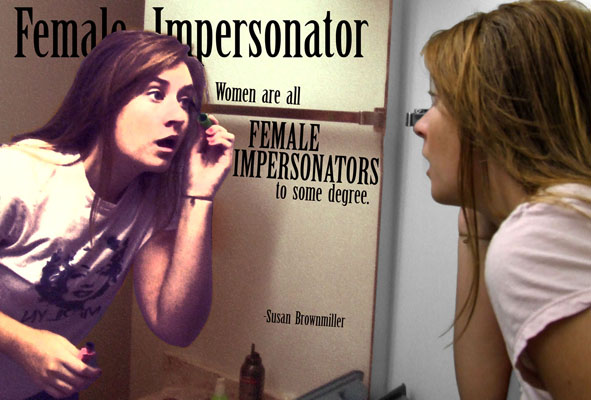
My photographer got my photos to me the day after they were taken. I had decided to leave some of my clothes on for the photo shoot, and I was eager to see them, so when I got the CD, I immediately uploaded the photos to my computer. I quickly realized that I couldn't go through them. I had already finished the shoot, the supposedly difficult part, and now that the pictures were sitting in front of me, I couldn't look at them.

I looked through a few of the first ones, and, to be completely honest, I was disgusted. Not with the photos themselves: they were of very good quality. But the fact that they were of me (and me partially nude!) made me feel sick to my stomach. This feeling broke my heart. After being such a proponent for this photo shoot, I couldn't stomach my own pictures. I knew that wasn't the good feminist reaction I was supposed to have, and it upset me greatly.

It made me think of how deeply embedded my body issues must be, and I can't even pinpoint a source for them. I'm upset because I feel like this opportunity that should have been a positive one, has been ruined because of my intangible issues with my appearance. I'm not giving up, but damn. This sucks.
Wednesday, December 17, 2008

Weight-preoccupation and the holidays

I have been super busy with the end of term in late November, finishing my novel that I wrote in 26 days for National Novel Writing Month, and the holidays, so I apologize for my lack of posting lately.

But while I was on my blog break I was dealing with a problem that I have been thinking about recently from a feminist perspective. It's a problem that many women face in this society that (no matter how many exceptions anyone tries to name) pushes women to extremes when it comes to their physical appearance. The issue I have been facing has been weight-preoccupation.

It isn't an eating disorder like anorexia or bulimia, but it is a real problem. Personally, my weight-preoccupation means that I get so concerned about what I eat and how it effects my outward appearance that I end up feeling bad about myself to the point of my bad feelings consuming my thoughts. When I was in high school these feelings often meant that I would eat a meal, feel bad about it, and exercise until I worked off all the calories I had just consumed (and then some). I used to spend hours riding a bike every day in order to justify eating a full meal. Now it just means feeling guilty and unattractive, which isn't any better.

The holidays are awful for me when it comes to my relationship with food and my feelings of self-worth. I'm home from college which means more food is available to me, and it also means that my family is baking a lot more than usual. Cookies, breads, and lots of other sweets are in abundance around here and every time I put something in my mouth, I am overwhelmed with a feeling of shame. Luckily I have not reverted to my old habit of exessive exercise, but that means I am left feeling unattractive. All because I indulged in a little holiday cheer.

It makes me so mad when I feel like this, but that doesn't help make it go away. I know that I am a beautiful person because of my accomplisments and what I have to offer as a person. But it seems that during the holidays none of that matters because all I can focus on is how unattractive I must be for eating some cookies...because the women on TV and in the magazines scattered around my house, none of them look like they have eaten any cookies.