Showing posts with label Body Image. Show all posts

Monday, November 15, 2010

Fitness is Not Necessarily Thinness

Morning Gloria over at Jezebel wrote a great piece railing against America's obsession with weight as a measure of fitness, something I have complained about (in a less articulate way) in the past.

There are lots of great parts of the piece which I suggest you read in its entirety, but you can get the jist through the below summary.

I bought a women's fitness magazine the other day and almost every page equated fitness with losing weight. Get bikini ready in seven days! Lose 12 pounds by tomorrow by doing these three exercises! Hungry? Eat seven almonds! Fuck that.

Your body was made for so much more than being looked at, deprived of food, and enjoyed by others. Your body was made for kicking some ass.

...


Discussing exercise or athleticism is tricky in the context of body acceptance; we're told the only reason we'd possibly want to exercise is to have a sexy body or to be smaller or more in line with what society has determined is an acceptable size.

...


You guys. This is bullshit. Physical fitness doesn't have to be about anyone else but you or about anything else but becoming stronger. It's time we stopped associated exercise with a form of conformity and surrender, because do so is to deprive yourself of the potential that your body offers you.

Thursday, July 22, 2010

America’s Obsession with Weight: Health Care System Edition

The way medical professionals talk to women about weight makes me so angry sometimes. The conversation never seems to be about nutrition or fitness when we talk about women- even in a doctor’s office. It is about weight loss, weight management, and weight control. My doctor never asks me if I exercise regularly or if I eat my 5 fruits and veggies a day- he just weighs me, like that reveals all there is to know about my overall fitness level.

This obsession with weight is not only a reductive way to look at overall health, but it can be dangerous. Eating disorders
are on the rise in the U.S., partly due to our culture’s obsession with weight. If you are a young person who is at risk for an eating disorder, the last thing you need is your physician reinforcing the attitude that weight is everything.

Of course, like with most bad things, women suffer from our health care system’s obsession with weight more acutely than men do. A
recent study revealed that doctors “recommend greater weight loss to female patients than to equivalently overweight male patients.” It is unclear why this is, but the study’s authors suggest “societal bias is one possibility.” I understand that doctors are just people, and that they internalize the same impossibly thin images of women that we all do. But, really, if doctors can’t be objective about what is a healthy weight for a woman, who can?

I am particularly upset about this tonight because of an experience I had in doctor’s office waiting to be tested for strep earlier today.


I had waited for four hours when a young-ish physician’s assistant called me in. He took my temp (I still had the fever I had that morning) and asked me to step on a scale.

He asked me how much I weigh as I stood on the scale and I gave him a rough estimate. As the numbers got larger he said, “Well, someone has been eating some barbeque.” As the numbers got even larger, he said “Well, someone has been eating a lot of barbeque.”

I let him know, in words only someone with strep who has been waiting four hours can, that he should shut up.

Later, the asshole came in again. As he was putting the cotton swab down my throat he remarked, “For someone so uptight, you don’t have much of a gag reflex.”

I reminded him that there are laws against sexual harassment, finally got someone else to help me, and later filed a complaint.

When he made the first comment about barbeque, I thought maybe he was just an asshole, not necessarily a sexist one. When he made the crack about my gag reflex, I knew he was sexist and suspected that might have been the reason he thought it was okay to insult my weight.


When I heard from the other room that his response after weighing an obese man was “Alright, step down, please,” my suspicions were confirmed.

So what have your experiences with medical professionals been? Have you ever experienced them making inappropriate comments about your weight or seen them treat women differently than men?

Come on; don’t leave me ranting here alone.

Monday, July 19, 2010

18-year-old singer gets Botox to prepare for Glee debut

From time to time I come across random things on the internet that really kind of worry me. This is one of them.

Charice Pempengco, an 18-year-old Filipino singer who recently released her first album, prepared for her debut on the show Glee "by getting Botox and an anti-aging procedure".

Charice's publicist insisted that the Botox procedure was undergone for muscle pain and not for cosmetic purposes, but that seems to be thrown into question when the singer is quoted as saying (emphasis mine):

"All people will be anticipating how will Charice look? Is she good enough to pit against Rachel Berry? So of course there is tremendous pressure," Charice said.
And the cosmetic surgeon who worked on Charice, Vicki Belo, said that the singer underwent a 30-minute procedure to make her round face more narrow. Belo also said (emphasis mine):

"You chew gum and it turns out to be a favorite super-exercise for these muscles, your chewing muscles. So we will show you, this muscle here it's a bit protruding," Belo said as she touched Charice's face. "It's like a ball, so we are going to Botox that in order to get it flat so she will have a cuter face ... we want to give you the apple cheek look because it's cute, right?"
To me, that indicates that while perhaps there was some muscle pain that the singer was dealing with, that beauty was definitely also part of the equation.

Because in Hollywood you're never too young to start suffering for beauty's sake, right?

Wednesday, April 14, 2010

Britney Spears challenges photo altering

Please read this letter to Britney Spears, written by Melissa at Shakesville.

In it, Melissa mentions how Britney decided to release, side by side, both unaltered and altered photos taken during a recent shoot for Candies.

These kind of made my day.

Tuesday, April 6, 2010

When beautiful isn't beautiful...

...unless it's impossible.

The woman on left is Kimora Lee Simmons. I'm not sure who that is on the right, but I think we're supposed to believe that she is Kimora Lee Simmons.

h/t

Monday, December 21, 2009

Fat acceptance for 4 year olds

Today while reading a story with one of the PreK students I work with, she stopped me in the middle of the book to ask me a question.

"Am I fat?" she asked.

"No." I said.

"Am I skinny?" she asked.

"You know what?" I said, "Everyone looks different. And that's ok. Do you look the same as me?"

"No."

"Do I look the same as (another student)?"

"No."

"Does (another student) look the same as (another student)?"

"No."

"We all look different. And that's not bad. It's good. It's ok that we all look different."

And then we started talking about the different ways we get to school in the morning and how she wanted a bike for Christmas.

Now that I've had the chance to think about our talk, I wonder if I wasn't clear enough. If I didn't state explicitly enough that she is wonderful just the way she is. If I could have made her understand that her body is her own, to be judged by no one. If I should have used words like acceptance and love instead of different and ok. If when the other teacher called her "our big girl" and told her not to eat quite so much, I should have done ... something. Anything.

My student is 4 years old.

She is facing a lifetime of societal messages telling her to be thin, white, blonde, tall, physically able and more from every angle, explicitly and subconsciously. Already my students dress up as Belle, Cinderella, Sleeping Beauty and other princesses that don't look like them.

Since the outside forces of society are so strong, should I have been explicitly clear that her body shape does not define her? That there are more people who don't look like Cinderella than do? That the standard of beauty is constructed to be impossible? How can I use my limited role in her life to help her accept herself?

My student is 4 years old and asking me if she's fat. How can I ever do enough to help her?

Friday, October 9, 2009

Impossibly beautiful but in your face

How can I respond to this Facebook request from a high school friend in a thoughtful, constructive and feminist way?

Photoshop the Ugly out of your pictures

Hello all, I'm working on a project right now where I want to
show my skills retouching photos in Photoshop. I need some before photos so I
can make some lovely afters. So it would be awesome if you could send me photos
that you have that could use some free retouching. I'm looking for photos that
have:

Acne, wrinkles, arm fat, tan lines, etc. that you would like
removed

old photos that have dust spots, scratches, smudges, etc.
bad lighting
a sign or some small object removed

I could even do fun things like maybe add some bling to you,
add a new hair do, give you more muscle definition, put your face on a hot
ladies body, whatever you wish, just let me know.


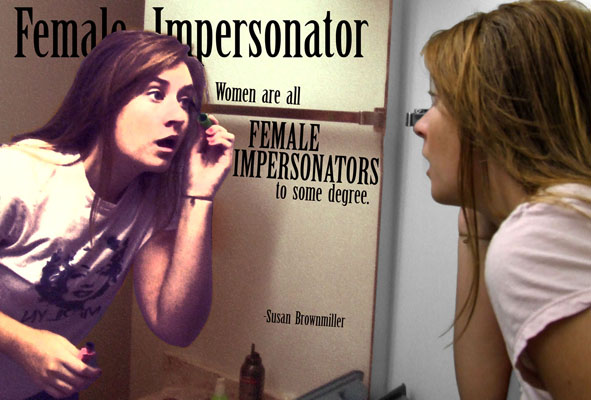
I know this woman from high school and she was calling herself a feminist before I was. I know she works in graphic design, but how can I explain (in a context on Facebook) what exactly my issues are with her work? Any ideas, Impersonators?

Sunday, June 28, 2009

Apologies and Excuses: Eating as a Pathology

This summer I’m doing research at my college, and I’m living with two roommates. Something I’ve noticed is that I’ve been actively avoiding eating in front of them, and I think this tied into a larger theme common to many women: Food guilt.

At my college, I have worked for the past two years at a small convenience store on campus. The store is frequented by a large number of students and is an employer of many more. One of my main tasks as a student employee is to check people out at the register, which means that I get to know, or at least recognize the faces of, the people who shop at the store.

I quickly noticed a trend in which female customers would come in, bring what they deemed “unhealthy” foods (ranging from a bag of Cheetos to a bottle of Coke) to the register and make excuses, either to me or whoever they were with, about why they were purchasing such items, despite knowing how “bad” they supposedly were. Other female customers would bring a basket filled with food to the register and quickly go on about how they hadn’t eaten all day, how it was for their friends, or something similar, as if they needed to provide a reason for buying so much to eat. And there were others who I saw more often and who obviously recognized me, who would some in and say things like, “I’m sorry that I come in here all the time. You must think I’m fat for buying so much food.”

The strange part about all this is that when I was working and I encountered women saying such things, I thought it was really odd. But whenever I went to buy food at the same place, I always secretly wondered what the student cashiers thought of me and the food I was buying.

The other strange thing was that no matter how much, or what kinds of things, the male customers I saw purchased, they made excuses and apologized drastically less frequently than their female counterparts.

As I recall these experiences, all I can think about is how, for women and girls, relentless socialization has turned eating into a pathology.

From a young age, girls are taught that appearances are important to their identity. They are socialized into this in many ways, ranging from the types of compliments they receive (“You look so pretty!”) to the kinds of play things meant for people of their gender (Barbies, princess dress up clothes). This appearance-centered world that girls are socialized into is made more problematic when it’s coupled with the narrow ideal of female beauty: being flawlessly thin.

For women, eating is not merely about nutrition. It is seen as a disorder, a pathology. Women are taught to control their bodies through controlling their eating habits with the help of diet plans, low-fat food, diet soda, and other such products. If a woman eats, she is often made to feel as if she has “let herself go,” as if she does not care about her body the way she should, as if there is something wrong with her.

And so women who come to buy food at the convenience store at my college campus make excuses for their purchases have clearly internalized the messages from the greater society that say that eating is a poor reflection on them – that it is a disorder.

As a young woman who deals with this problem every day of my life, who feels extreme guilt for eating anything and who feel hyper-aware of how other perceive my eating habits, I have not been able to fully explore all the reasons and meanings behind this issue. But I do hope to write about this more in the future.


NOTE: The main idea for this post came to me after reading Reading Ads Socially by Robert Goldman. In chapter 5 of this book, Goldman writes about how advertisements contribute to the notion that if women don’t add up to the idealized image of female beauty, that they have a flaw. I thought this point fit particularly well with my experiences and the common problem of women’s messed up ideas about eating.

Monday, April 27, 2009

Too ashamed to age

Recently, I've been particularly interested in the health sections of the different online news sources that I read. When I came across this story, I already had an idea of what it would be about before I even read it: Older woman thinks looking younger through surgery will lead to her feeling better about herself, and she has these feelings validated by others who compliment her on her newly attained looks. Turns out I was right.

I can't say I'm against cosmetic surgery, because I feel that doing so would be an infringement upon a woman's right to choose what she wants to do with herself, which I believe in strongly. But I do have a problem with women in many societies having to deal with the idea that age is something to be ashamed of and youthful looks should be sought at any price.

In the article linked to above, Janet Cunliffe, aged 50, said she wanted to look like her daughter, Jane, who is 29 in order to gain some confidence about herself.
"I decided to do it because I was feeling low at the time, I'd just come out of a long-term relationship, so just to boost my confidence. My daughter inspired me at the time, so I just wanted to look like her and to make me feel a lot more youthful and to give me some confidence."
The problem of correlating one's physical appearance with one's worth is such an integral part of being a women in many societies that it's sometimes one that isn't thought about. It's definitely an issue that I struggle (often unsuccessfully) to think of ways to conquer in my life.

And this article, I feel, is not helpful. It draws attention to this woman because she has completely bought into the troubling idea that appearing youthful is the only way to feel good about oneself after reaching middle age. It validates her feelings of discontent with appearing her natural age, and helps give reason for other women to feel the same way.

So, question: How can we make this cycle stop?

Friday, April 24, 2009

"Skinny Bastard" by the authors who brought you "Skinny Bitch"

I remember the first time I picked up a copy of Skinny Bitch, I was with my mom and sister in Barnes and Noble and my mom was looking at diet books for herself and my stepdad. I can't remember if it was my mom or my sister who first picked up Skinny Bitch, but I was instantly put off by the title, took a look at one page, and was completely turned off by the language used. I didn't have to read very much to realize the main tactic the book's authors was using: Fat-shaming.

Having not actually read this book, I can't say whether or not the authors included discussion of health benefits when it comes to striving for healthier eating, but to me, it seems clear that their main goal is to use shame to get people to buy their book and try to change their eating habits.

Because why rely on the information you have about the importance of eating healthy when you can scare women into buying your diet/lifestyle ideas by hanging the f-word over their heads where it can thrive on their possibly low self-esteem?

Well, Rory Freedman and Kim Barnouin, the authors of Skinny Bitch, have written a book called Skinny Bastard, which will go on sale Monday.
“Skinny Bastard” follows roughly the same outline as “Skinny Bitch,” with the language retooled to appeal to male psychology. Whereas the introduction to “Skinny Bitch” reads, “If you can’t take one more day of self-loathing, you’re ready to get skinny,” the men’s version does not assume low self-esteem: “Chances are, you haven’t done so badly, despite the few extra lbs you’re carting around. ... But don’t kid yourself, pal: A hot-bodied man is a head-turner.”
The problem with even just this small amount of text, which I feel might be symptomatic of the entire premise of this book, is that it conflates physical appearance with the epitome of achievement and of happiness. Of course, there are benefits to being sure that one eats healthily, but one could do that and also not conform to the standard of physical beauty dictated by this society.

The problem of focusing on physical appearance above all else is something that effects people of all sexes and genders, and it often does not have good outcomes. The fact that these women seem to be targeting specific genders with specialized shaming tactics is really troublesome for me. It seems to be more problematic in Skinny Bitch than it might be in Skinny Bastard (the authors added a chapter about heart disease and prostate cancer to highlight health benefits in this book), but the overarching problem of thinking one physical appearance (aka "skinny") is the "right" kind, I imagine is still there.

Granted, I have not read either of these books, but the authors really make no effort to try to conceal their methods, even on their website. If anyone has read Skinny Bitch, please feel free to leave your opinion on their tactics as a comment.

If you haven't read this book, would you buy a book with a title like Skinny Bitch?

Tuesday, April 14, 2009

Why I don't (normally) miss TV: Part two

EDIT: In the ten minutes that it took to write this blog post, this Nutrisystem commercial featuring Jillian Barberie Reynolds was removed from Youtube. Not really sure what happened. Edit part two: Apparently it's back? Sorry!

When I'm at school, I try to limit the amount of TV I watch. But it really seems as if every time I happen to turn the TV on, there's an annoying sexist advertisement on. I came back to the room for lunch today, and Kate was watching TV. In less than an hour, I've seen at least three Nutrisystem commercials, including the one below. The other one that played twice I couldn't find to show here.


There are several issues with this commercial.

First, it uses a spokesperson whose body type is just not going to be achievable for most people looking into the Nutrisystem option.

Second, she tries to sell herself as being into "manly" things, like playing football and eating pizza and burgers. When she mentions a more stereotypically "feminine" type of food (chocolate) she puts her hands around her mouth and lowers her voice, as if its something to be ashamed of.

Third, in the version of this commercial that I saw on TV, there was a website on the screen that read "www.nutrisystem.com/pretty" which gives the impression that the only way a woman can be "pretty" is by having the disposable income to go on a diet plan in order to lose weight.

This just makes my day. Being bombarded with commercials on several different channels that are trying to convince me that I am not "pretty" enough unless I lose some weight. One reason why I normally don't miss watching TV.

Other parts in this series: One.

Friday, February 20, 2009

Expanding "Beautiful"

Last weekend our campus feminist group (SASS) held a "Love Your Body" weekend. Last night at our group meeting, we reflected a bit on how the weekend had gone and how we might be able to address some of the problems people had, especially with the photo shoot, in the future.

When I first expressed my unsatisfactory experience with an event that I had helped plan for two years, an anonymous commenter wrote, "the master's tools will never dismantle the master's house" and that really stuck with me. Then last night at our meeting, it was brought up that although our "Love Your Body" weekend was a good way to expand the definition of physical beauty, the way we set things up we (inadvertently) gave physical beauty a priority. And that, to me, was exactly why I was not completely satisfied with my experience. I was using the master's tools to try to dismantle the master's house.

In this society, women are expected to be beautiful according to standards set up by those with the power (white males). These standards are not only narrow and unrealistic, but they are meant to be the only standards for what makes a woman (or person) beautiful. I realized that this is why I am not completely happy with this past weekend that was supposed to be an empowering experience.

As long as I continue to think only within the confines of the male-dominated ideals of female beauty, which are strictly physical, I will never be happy with myself because these ideals were not made in my best interest.

Beauty, I finally, truly realized, is not only a physical concept.

I am beautiful because I can express myself with words.
I am beautiful because I have my own, unique thoughts.
I am beautiful because I am not easily intimidated by other who disagree with me.
I am beautiful because, for the first time, I am shedding the chains of a system that was maintained because I did not feel beautiful.

It was such an epiphany I had last night. I know this is only the first step in a long process of overcoming the deeply embedded idea that beauty is physical and that only one kind of physicality is beautiful, but it feels so good to finally be there.

Sunday, February 1, 2009

Confession: I still don't love my body

I got involved in the feminist group on my college campus (Students Against Sexism in Society, or SASS) fairly quickly after I started school. Last year I was involved in helping planning our Take Back the Night event that also included a nude "Love Your Body" photo shoot.

I wanted to help with the photo shoot because body image issues were one of my main motivations for getting a start in feminist activism, and this photo shoot was meant to help people see their bodies in a positive light and to help them appreciate a diverse range of body shapes.

This year, instead of combining the Love Your Body photo shoot with our Take Back the Night activities, SASS is putting on a separate "Love Your Body Weekend" February 13-15. Friday, we booked a local place to display the photos of over 60 nude models from campus. We will also be having an open mic for anyone who wants to present something relating to body issues, whether its a piece of music/art/prose by someone else, or that they composed. Saturday we will be painting tampon boxes from bathrooms on campus, having a discussion, and Larry Kirkwood will be coming for an exhibit/speech. Sunday we will be having another discussion.

Last year I decided not to participate in the Love Your Body photo shoot. This year, however, I did participate. I went into it thinking that it would be a good opportunity for me to see my body in a new way, and hopefully gain more appreciation for it instead of constantly seeing it so negatively.

My photographer was wonderful. I chose him because I had seen his work before and knew it to be quality. When I arrived for my photo shoot, I was nervous, but he struck up a conversation with me as he set up his equipment, and when it came time for it, I felt comfortable enough to go through with it.

This photo shoot is set up with some guidelines. First, poses, amount of clothing, and what was photographed was all left to the models. Second, all photos included in the display must be in black and white with no faces and only skin showing, even if the model kept some clothes on. Third, the photographers would take the photos, edit them, and then give on a CD to the model so they could choose which photo would be included in the display.

My photographer got my photos to me the day after they were taken. I had decided to leave some of my clothes on for the photo shoot, and I was eager to see them, so when I got the CD, I immediately uploaded the photos to my computer. I quickly realized that I couldn't go through them. I had already finished the shoot, the supposedly difficult part, and now that the pictures were sitting in front of me, I couldn't look at them.

I looked through a few of the first ones, and, to be completely honest, I was disgusted. Not with the photos themselves: they were of very good quality. But the fact that they were of me (and me partially nude!) made me feel sick to my stomach. This feeling broke my heart. After being such a proponent for this photo shoot, I couldn't stomach my own pictures. I knew that wasn't the good feminist reaction I was supposed to have, and it upset me greatly.

It made me think of how deeply embedded my body issues must be, and I can't even pinpoint a source for them. I'm upset because I feel like this opportunity that should have been a positive one, has been ruined because of my intangible issues with my appearance. I'm not giving up, but damn. This sucks.

Sunday, January 11, 2009

My friend, the (secret) feminist

Last night I was up until 4 a.m. talking with a good friend of mine who lives in my suite at school. She has been friends with me through my feminist transformation and is now taking a Gender and Women's Studies class in order to fill her diversity credit.

We watched Mulan last night because neither of us had any work to do, and I found myself pointing out all the gender stereotypes in the movie (even though Mulan is by no means the worst in this arena). I apologized to my friend for possibly annoying her, and she told me that she had never thought about this movie that way before. We had a brief discussion about movies as agents of socialization and how the Disney princess movies often promote sexist ideas, and she decided she might give a presentation in her class about these movies.

It was nice to see her make sense of something relating to feminism and find it interesting.

Later, we went to my room and had a long talk that evolved into body image issues. I talked a lot, as this is my pet cause as a feminist, and I realized how difficult it is to pinpoint the specific causes for these issues within specific people, and how hard it is to change one's thinking once these ideas manifest themselves.

My friend also had a lot to say about these things, and in a lot of ways we are similar. We both have issues with our bodies, and we both know that some of the things we say/think are based on falsely held ideas and are often not fair. But we can't seem to change the way we think. We are both victims of female oppression in a society that holds beauty as a marker for success and worth above all other measures, and the marker is set unbelievably high.

The only difference between my friend and I when it comes to issues of women's rights and certain invisible oppressions is that I identify as a feminist and my friend does not. She said that she does not think of herself as a feminist because she's not "active about it" in the sense that I am with this blog.

Well, dear friend, I want you to know that you are a feminist. If you don't want to call yourself one, that's fine, but your ideas and beliefs when it comes to women's rights make you a feminist.

EDIT: I just checked my e-mail, and saw this article. Apparently, losing weight is so important that people might want to start creating false memories about bad experiences with fatty foods so they won't crave those foods.
"Although it's not ethical to create false memories in people, making an association between eating a fattening food and getting ill may be beneficial," says Elke Geraerts, a psychologist from St. Andrews and lead author on one of the studies. "People may avoid those foods in the future."
It's not ethical, but hell, if I can lose weight, sign me up!

Thursday, January 1, 2009

My Feminist New Year's Resolution

I don't usually make resolutions, but this year I decided on one.

The inspiration for it came from a tattoo I found on Flickr that said "delete the adjectives." It was inspired by a quote in Harper Lee's To Kill A Mockingbird that said, "Atticus told me to delete the adjectives and I'd have the facts."

So my resolution this year is to try to delete the adjectives, especially when it comes to negative ones about my body. I will try to stop thinking of myself as a "fat" girl with "puffy" eyes and "huge" thighs.

I hope that by deleting these negative modifiers I will be able to focus more on things I hope to accomplish and do so with a better outlook on myself and my life.

Wednesday, August 13, 2008

A little Tyra love

I'm not going to lie, there's something I really like about Tyra Banks. Sure, America's Next Top Model probably isn't the best vehicle for promoting body acceptance, but it seems like the show is attempting to alter industry standards, from having the latest winner by a size 8 "plus size" model (problematic but better than another size 0 winner) to having a trans contestant this season.

Plus, you gotta love someone who does this:

Friday, August 8, 2008

Advice for the question "Have you lost weight?"

It's my grandparent's 50th anniversary this weekend, so they're having a party and I'll see them this weekend. Usually when I see my grandma, she says something along the lines of "Have you lost weight? You look thinner."

I never know what to say to this because 1-I don't have a scale or keep track of my weight so I literally have no idea, 2-My weight as a number doesn't matter to me, 3-My weight seems pretty stagnant for the past few years, so it's not like there would be vast physical differences. She says it practically every time I see her and I'm guessing it's one of those things she thinks would be a compliment (because all women worry about weight, right?). However, it just makes me uncomfortable because I never know what to say. I usually sputter something like "Um, I really don't know," and then change the subject.

For me, health is more important than weight. I try to eat well, although that's not always successful (I'm looking at you, cookies) and this summer I've started biking to class in the mornings and then taking my bike with me to work for the rest of the day. It usually ends up to about 5 miles each day, plus the longer weekend trips I take. Because of that added exercise, I think I have lost some weight this summer, mostly measured in belt loops and baggier clothes.

So what do I say now? And why do people feel the need to randomly say, "Have you lost weight" as a compliment regardless of whether someone has or not? I need your help here, friends.

Thursday, July 10, 2008

On Staying Single

Notice that I am not just single currently, but that I am  staying single. This was not a conscious decision. I did not sit down one day, feminist ideology in hand, and decide to stay single for political reasons. It just happened. I haven't been in a relationship for two years. For a woman in her twenties, this is so odd as to be alien.

When I was in middle school, nothing could have been more important than being in or wanting to be in a relationship. Boys were just beginning to notice me, probably because I was one of the first girls to have her breasts grow beyond the mosquito bite phase. Luckily for me, I did not grow up in the Paris Hilton era. Britney Spears was still keeping most of her clothes on the late 90s when the pre-teen girl uniform of choice was polo shirts, short shorts, and high ponytails.

Regardless, my desire for a boyfriend and to look good had nothing to do with my sexual desire. Although I had curves and breasts to rival any grown woman, my sexual drive had not matured. I heard about masturbation, mostly from the eighth grade boys, but such things held no interest for me. Even the extremely progressive books on puberty that my parents bought me detailed male masturbation explicitly, although some of them spend a bit of time on female masturbation as well. Curious, I attempted this masturbation a couple of times. Nothing really much happened, presumably because my sexual drive had yet to develop (it would in high school), so I gave that up.

Why then, was the pinnacle of pre-teen social life the drive to attract boys? I obviously did not know what to do with them when I got them, and I had no sexual desire for them. I was putting on a performance, plain and simple. The dominant social message of the time, and I assume it has gotten worse lately, was that a girl should aim to look sexy and have sex, but her own enjoyment of the sexual act had nothing to do with it. This held true for my twelve year-old self: I was not attracted to boys in a sexual manner, and I had no personal desire for sex. I was simply responding to social norms. If I said a boy was cute, it was not the case that I was attracted to him. I simply recognized that he fit within the acceptable range of male appearances, and I wanted him to want me. My desires did not play into the equation at all.

As I moved on from middle school and entered high school, my sexual drive finally blossomed. I had a healthy desire for sex and masturbation by the time I was fifteen. Still, however, I cannot think of a time that I wanted a boy more than I wanted him to want me and the social power I would gain by being sexy and attached to a suitable male. I was also doing battle with my monstrous crush on my female friend at the time by denying to myself that I probably was not as straight as I would like to be. Nevertheless, the idea of a boy competing for me or spending time on his appearance for me was laughable. By the time elaborate hair and makeup routines were the norm for girls my age, boys had yet to grasp the concept of showering daily.

Simply put, being sexy was more important than being sexual. The conflicting messages of abstinence and MTV had done battle, and the result was "be sexy, be hot, be available and wanted. Your sexuality is shameful." It was not important that boys were attractive, and they largely were not, it was important that I was attractive to them. Due to my extremely extroverted personality and unwillingness, even then, to play weak or dumb, I never succeeded.

In college, the drive to be wanted and not to want became funny in its intensity. The antics of my peers inspired mental images out of a porno: buckets of male ejaculation everywhere, but no elusive female orgasm. Men were still boys, and still had not grasped the basics of hygiene that were common sense to the average eleven year-old girl. And why would they? All around them women were wearing next to nothing and viciously fighting for their attention with deeper tans, deeper v-necks, and higher shoes. All they had to do was sit back and enjoy.

After a disastrous series of boyfriends where the male orgasm was far more present in our relationships than the female orgasm, I had the luck to fall into Feminism by way of a Women's Studies course. Among the considerable changes in my life, I stopped wanting men to want me if I did not want them back.

Simply, if my sexual pleasure had no part in the equation, I wanted nothing to do with men. If they were not attractive, their attention was gross and creepy. It was surprisingly easy to find my dry spells becoming longer and longer, only broken up by my mostly pleasurable forays into lesbian relationships.

How was this so? Once I gave up performing the sexy routine, guys largely did not want me. Which was fine with me, because most guys my age hadn't touched a razor or bar of soap in half a week. My university was like a scene out of a pornography: most of the women were conventionally attractive, but the men were as lazy with their appearances as they were with their health.

Today, I find it pathetically funny how my pursuit of my own pleasure--wanting attractive men, wanting sexual fulfillment--removed me from the dating scene. By raising my standards to men that I wanted, instead of men that wanted me, I had to find men that spend a comparable amount of time on their appearance and would be invested in my pleasure as much as their own. Unsurprisingly, the men who spent as much time in front of a mirror as I did (which wasn't much, considering that I stopped tanning and wearing large amounts of makeup) were the ones that dated the most feminine women, who had the personality of swine, or who were more interesting in acting out their favorite pornography than pleasing their significant other.

What I realize today is that the dating scene revolves around male pleasure. Male orgasms, male lust, male appreciation of beauty. If I wanted female orgasms, my lust, and my appreciation of male beauty I was holding out for something that did not exist. Or, if it did, it was not available to me once I stopped tanning, obsessing about how flat my abs were, and wearing hundreds of dollars of makeup.

In conclusion, I stay single because it's pathetically easy, but not by my design. Perhaps one day I might stumble upon a man who is as invested in looking good for me as I would be invested in looking good for him. Instead of me wanting him to want me and him wanting me, I would want him and he would want me. Then we could meet in the middle, form a relationship based on mutual attraction, admiration, and lust.

How sad that society has made such things the exception, and not the norm.

(Cross-posted)
Tuesday, July 8, 2008

Body Positivism: Health in a post-BMI Mentality

One of the most valuable things I have taken away from Feminism is how to love myself and everyone, no matter what shape they are. I especially have to give a hat tip to the lovely ladies over at Shapely Prose for all of their hard work. I feel like the battle to accept myself, and others, is constantly uphill. The work of feminists and fat acceptance activists has helped me increase my self esteem and be healthier, mentally and physically.

Nevertheless, various health issues connected with food run in my family. For years, I struggled to control my intake and exercise religiously. This struggle was mostly fruitless, because I love to eat and cook. Running in place on a treadmill was nowhere near as fun as inhaling the heavenly aroma of home-made risotto as I stirred it on the stove, and then receiving glowing compliments on my culinary abilities from my family and friends.

The age-old "diet and exercise" shtick wasn't sticking. Fat Acceptance mentality in tow, I decided to go to a friend-recommended local nutrionist for a check-up that I refused to receive from my weight-obsessed general physician.

Before she began, I set a few rules. No talk of BMI. No discussion of weight and "weight classes". I stressed that I really did not care about what size I wore. I wanted to know if I was getting the right vitamins, if my cholesterols were in balance, and I could pass basic physical fitness tests. In short, I wanted to know everything worth knowing, and nothing that wasn't worth knowing. If I was healthy and moderately fit, I didn't need "weight loss tips".

She agreed, thankfully. I don't know how well such rules would have worked for regular nutrionists (she was more of the natural hippie variety), but she was perfectly agreeable, and understood why I asked her to leave such inconsequential things out of my check-up.

I passed the physical fitness tests, with moderately high endurance ratings, but low strength ratings. She said those could be increased with more fiber in my diet and simple things like carrying more grocery bags at once. I'm awaiting my blood and urine tests though.

I feel like looking after my health in this fashion is much more productive. Weight does not really determine a lot of health issues. I could have the body of a super model, but be malnourished. I could be as toned as an Olympic athlete, but have serious cholesterol issues. More than weight and BMI, excesses and deficiencies of certain vitamins and minerals in your blood are responsible for various ailments. Besides, dieting has been found to be useless in the long run, and a constant drive to "improve" my body, on the assumption that it is "bad", is not healthy mentally or physically. My intestinal disorder and allergies can and have put me in the hospital. I have no wish to screw around with food unnecessarily.

Fat Acceptance and health are not mutually exclusive. In fact, I have found them to be very inclusive indeed. Here's to enjoying food, my body, and my life!

(Cross-posted)

I'm Annoyed: French textbooks

I'm learning French this summer and we started the chapter on food, restaurants and eating today. I have to say, it annoyed me to no end how along with names of different foods, we learned "diet," "to get thin," "to gain or lose weight" (two different verbs). Additionally, during an exercise where we went around the class asking people different things about meals (favorite food to eat while sick, etc), one of the questions was "do you only eat salads when you're dieting?"

The French language has annoyed me already simply through its use of masculine and feminine words, but today, my disappointment was directed more towards the textbook authors. They knew it was for a college audience - did they need to include words about losing weight in a chapter on food?

Two big thumbs down for Deux Mondes.

UPDATE: Even better! The online homework is aaallllllll about counting calories and losing weight. No big thumbs down anymore - Screw Deux Mondes and their online practice exercises.