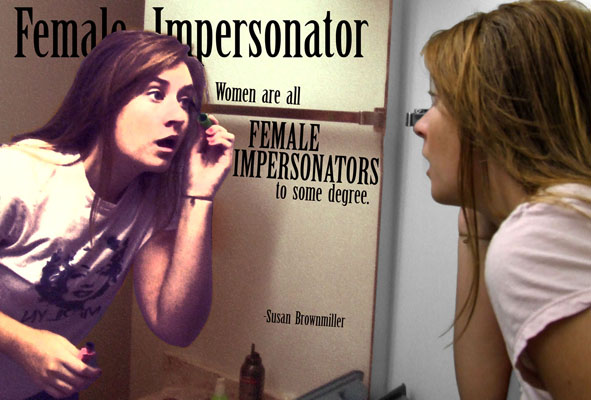
I came out as queer in 2009. The reason this subject has been on my mind lately has everything to do with the use of labels, my family, and the holidays.
For several years I’ve applied several labels to myself without problem. In 2005 I took on the label of liberal. In 2007 I took on the label of feminist. These labels I wore with pride, and they seemed to fit me comfortably. When I came out as queer, however, the taking of that label felt different to me. It was an appropriate label, but it just didn’t feel the same.
It was when I started coming out to people that I decided against the term bisexual and went with queer instead. However, when getting to know new people, I didn’t always use the term queer. It wasn’t that I felt ashamed of my sexuality, but openly applying the label with new people was a challenge for me, one that I didn’t seem to face when discussing the topic with people I had known before and had then come out to. The more I think about it, the more I’m convinced that it has something to do with the fact that the nature of the labels is different.
When I say that I’m a feminist, people may make assumptions about my attitude and my sexuality, but they also make assumptions about my ideas and my politics. When I say that I’m queer, people only have my sexuality to make assumptions about, and that hits a lot closer to home and is a lot more personal than when people have other things to assume. I’ve made a lot of progress in being comfortable with the label queer, and I’m wearing it a lot more freely than I did at first. But being at home with my family for winter break makes me feel like hiding again.
My sister is the only person in my family that I’ve deliberately come out to. I never did come out to my parents directly. They know because they found out who I’m dating. Since my sister and I have been home from college, I’ve talked to her about a plan I had come up with, one that I wouldn’t actually undertake. I wanted to come out to the rest of my mother’s family on Christmas Eve, before dinner, after the prayer, and after someone, as always, asks, “Any announcements?” I would tell my grandparents, aunts, uncles, and cousins something catchy like, “I’m here, and I’m queer!”
When I mentioned that idea, my sister cautioned me. She said that maybe queer wasn’t the best word choice. She said that some of my relatives may not understand what queer meant and that they might think that I only liked women. Although I disagreed with the tone of the statement which suggested that having people assume I was strictly attracted to women was somehow worse than liking men, women, and everyone in between, my sister did have a valid point.
There was an incident a few years ago in which some family members started talking about one of my second cousins. He is the only of three brothers who hasn’t gotten married and had children. He still doesn’t even have a girlfriend. My family discussed how, perhaps, he was gay. Several family members seemed unwilling to even consider the idea, appearing rather put off by the thought. At the time, the incident made me uncomfortable. Remembering it now makes me hesitant, especially considering that my mother’s family is rather religious, although not overbearing about their beliefs.
As the holidays approach, all I can think about is how my mother’s family is aware of some of the labels I wear, but not all of them. It doesn’t seem fair. The only reason I choose to wear labels is so that people who know me can have a better understanding of who I am. Labels are identifiers and are not static. Labels should evolve. New ones should pop up and old, inaccurate ones should fade out when a person changes. Can my family truly know who I am if they aren’t aware of a label that is important to me? Is it fair of me to not tell them something that might make them uncomfortable, even if I want to be open? Thinking about this, I need to decide which ones I’ll be wearing to celebrate the holidays this year with my family.
Showing posts with label Queer Culture. Show all posts
Showing posts with label Queer Culture. Show all posts
Wednesday, December 16, 2009


Wednesday, April 2, 2008
Love Revolution, Not State Delusion
 "Homotopia" is a short film about resisting gay-assimilation and all that it entails, and today, Amelia and I were able to attend a viewing of the film alongside a discussion with the filmmakers, Chris Vargas and Eric Stanley.
 So, what is gay-assimilation, and why should we be resisting it?
Well, these two rad, brilliant, and hilarious filmmakers explained that there is a prevalent normative culture in the United States. Basically, white, straight, monogamous, and capitalist men control the government, media, and cultural values. Those values include marriage and service in the military, two institutions which queer people are denied full inclusion in.
However, Vargas and Stanley are not advocating for the gay marriage movement or a change in military policies. They are working toward a different type of revolution, a revolution free from the social constraints of marriage and the violent imperialism of the military. This revolution,
 this Love Revolution, will be free from State Delusion because it will be free from all state institutions. Vargas and Stanley believe that the benefits derived from marriage, such as healthcare, should be individual and universal to all citizens, not just those who are married.
 The film was devastatingly funny, honest, and powerful. Its message was one of acceptance and rebellion, love and pain, fluid gender and rigid state institutions.
Chris Vargas and Eric Stanley are two of my new heroes: unapologetic in their sexuality and gender, living on the fringes of society, and just being awesome.
______
Hey, this is Amelia. I just wanted to add a short bit of explanation to this great post of Kate's. Kate and I went to this showing/discussion with very open minds. I will be honest, I did not know too terribly much about queer culture, but I attended this showing in order to learn more. I for one, will continue to attend such things in order to learn more so I will be able to present readers with a better idea of the different genders/identities/cultures in the world. I think exposure is an important step toward understanding, and it is a step I will continue to take.
Subscribe to:
Posts (Atom)

 Posts
Posts

